
Custom
Marriage
also: wedding
The lifelong union of a man and a woman, given by God in Eden. Jesus upheld it, the apostles taught how to live in it, and the Bible uses it as a picture of God's love for his people.
- Begun
- In Eden, when God made Eve for Adam (Genesis 2:18–24)
- Jesus said
- "What therefore God hath joined together, let not man put asunder" (Matthew 19:6)
- Picture of
- God and Israel; Christ and his church (Isaiah 54:5; Ephesians 5:25–32)
What it is
God made the first woman because it was not good for the man to be alone, and brought her to him. The Bible then gives the pattern for all marriage: a man leaves his parents, cleaves to his wife, "and they shall be one flesh" (Genesis 2:24). One man and one woman, joined for life: that was the plan from the start. Jesus pointed back to it when he was asked about divorce (Matthew 19:4–6), and Paul quoted it to the Corinthians (1 Corinthians 6:16).
How it was done
In Bible times parents usually arranged a marriage. Abraham sent his servant to find a wife for Isaac (Genesis 24), and Samson asked his parents to get him one (Judges 14:2). The bridegroom's family paid a bride price to the bride's father; Jacob worked seven years for Rachel (Genesis 29:20), and David paid his with Philistine foreskins (1 Samuel 18:25). An engaged couple were already bound to each other, which is why Joseph was called Mary's husband before the wedding (Matthew 1:18–19).
The wedding itself was a feast that could last a week (Genesis 29:27; Judges 14:12). The bridegroom came in procession to fetch his bride, often at night, with lamps and friends (Matthew 25:1–6). Jesus did his first miracle at such a feast in Cana (John 2:1–11). A newly married man was excused from the army for a year (Deuteronomy 24:5).
What went wrong
Men soon took more than one wife, beginning with Lamech (Genesis 4:19). The law allowed it and limited its harm, but the stories of Jacob, David and Solomon show the jealousy and trouble it brought. After the exile there is no record of it among the Jews. Marrying worshippers of other gods was forbidden, because it drew hearts away from the LORD (Deuteronomy 7:3–4; Nehemiah 13:26).
In the New Testament
Marriage "is honourable in all" (Hebrews 13:4), and forbidding it is a mark of false teaching (1 Timothy 4:3). Husbands are to love their wives as Christ loved the church and gave himself for her; wives to respect their husbands (Ephesians 5:22–33; 1 Peter 3:1–7). Marriage is for this life only; in the resurrection there is no marrying (Matthew 22:30).
Points to Christ
God calls himself Israel's husband (Isaiah 54:5; Hosea 2:19–20), faithful to an unfaithful wife. Christ is the bridegroom, the church his bride, and history ends with "the marriage supper of the Lamb" (Revelation 19:7–9). Every wedding is a small picture of that great one.
Key verses
- Genesis 2:24
Therefore shall a man leave his father and his mother, and shall cleave unto his wife: and they shall be one flesh.
- Matthew 19:4–6
And he answered and said unto them, Have ye not read, that he which made them at the beginning made them male and female, And said, For this cause shall a man leave father and mother, and shall cleave to his wife: and they twain shall be one flesh? Wherefore they are no more twain, but one flesh. What therefore God hath joined together, let not man put asunder.
- Ephesians 5:25–33
Husbands, love your wives, even as Christ also loved the church, and gave himself for it; That he might sanctify and cleanse it with the washing of water by the word, That he might present it to himself a glorious church, not having spot, or wrinkle, or any such thing; but that it should be holy and without blemish. …
- Hebrews 13:4
Marriage is honourable in all, and the bed undefiled: but whoremongers and adulterers God will judge.
- Revelation 19:7–9
Let us be glad and rejoice, and give honour to him: for the marriage of the Lamb is come, and his wife hath made herself ready. And to her was granted that she should be arrayed in fine linen, clean and white: for the fine linen is the righteousness of saints. And he saith unto me, Write, Blessed are they which are called unto the marriage supper of the Lamb. And he saith unto me, These are the true sayings of God.
Read next
 Place · GardenEdenThe garden God planted "eastward in Eden" as a home for the first man and woman, with every good tree, the tree of…
 PersonEveThe first woman, made by God from Adam's side to be his wife and partner. Deceived by the serpent, she ate the…
 PersonAdamThe first man, made by God from the dust and given life by his breath. His disobedience in Eden brought sin and death…
 Teaching · God's peopleChurchNot a building but a people: all who belong to Christ, and each local gathering of them. Jesus said he would build his…
 PersonAbrahamThe man God called out of Ur to a land he had never seen, promising him a people and a blessing for the whole world. He…
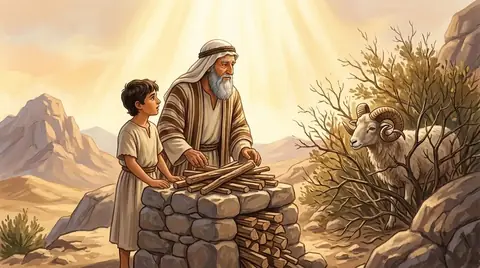 PersonIsaacThe son God promised to Abraham and Sarah when they were far too old for children, offered on Mount Moriah and spared.…
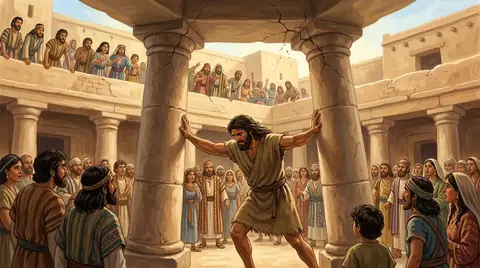 Person · JudgeSamsonThe judge of Israel with superhuman strength from God, a Nazirite from birth. He fought the Philistines single-handed…
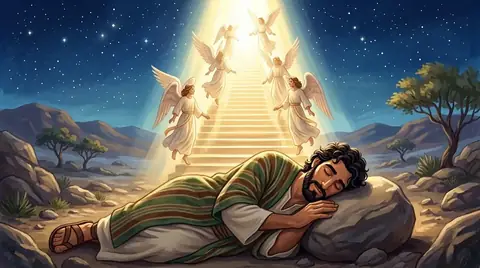 PersonJacobIsaac's younger twin son, who won his brother's birthright and blessing by cunning, was changed by God, and was renamed…
Written for this app in its own words, from the Bible, with the facts checked against Bible dictionaries and encyclopedias: Easton's, Smith's, Fausset's, ISBE, Holman, the New Bible Dictionary, Vine's and the Thompson Chain topics.
