
Group · Worship
The Levites
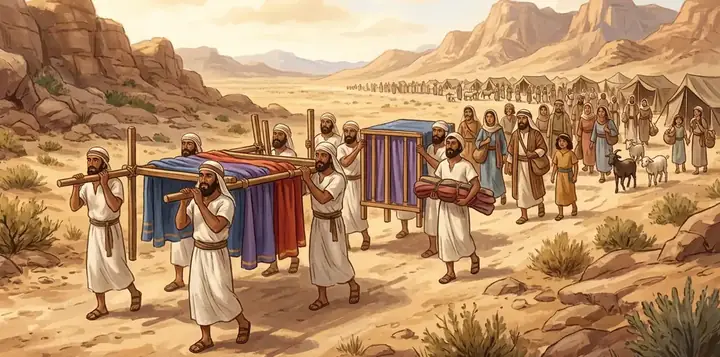
The men of the tribe of Levi, chosen to serve God instead of Israel's firstborn sons. They carried the tabernacle, later kept the temple gates, sang in its choirs and helped the priests, and lived on the tithes in forty-eight towns.
- Who
- All of the tribe of Levi; the priests were one family within it, the sons of Aaron
- Three clans
- Gershon, Kohath and Merari, each carrying part of the tabernacle (Numbers 3–4)
- Living
- No land of their own, but tithes (Numbers 18:21) and forty-eight towns (Joshua 21)
- Work
- Carrying and guarding the tabernacle; later gatekeepers, singers, musicians, teachers, judges and treasurers
Who they were
God claimed every firstborn son in Israel for himself on the night of the Passover. At Sinai he took the tribe of Levi in their place (Numbers 3:12–13). The Levites had earned it: when Israel made the golden calf, they alone answered Moses' call, "Who is on the LORD's side?" (Exodus 32:26). Within the tribe, Aaron's family were the priests, who offered the sacrifices; the rest of the tribe were the Levites, who helped them. The Levites were not counted with the fighting men, and they camped on the four sides of the tabernacle to guard it (Numbers 1:47–53).
Their work
In the wilderness each clan had its load when the camp moved: the Kohathites carried the ark of the covenant, the table, the lampstand and the altars on their shoulders; the Gershonites took the curtains and coverings; the Merarites the frames, bars and posts, on wagons (Numbers 4; Numbers 7:1–9). They served from the age of 25 or 30 to 50 (Numbers 8:24–25). When David brought the ark to Jerusalem and planned the temple, he gave them new tasks: gatekeepers, singers and musicians, keepers of the stores, judges and officials (1 Chronicles 23–26). They taught the law through the towns of Judah (2 Chronicles 17:8–9), and after the exile Ezra's Levites explained the law to the crowd so that they understood it (Nehemiah 8:7–8).
In the New Testament
A Levite passed by the wounded man on the Jericho road before the Samaritan stopped (Luke 10:32). Priests and Levites were sent from Jerusalem to question John the Baptist (John 1:19). Barnabas, the generous friend of Paul, was a Levite from Cyprus (Acts 4:36). Hebrews explains that the Levitical priesthood could never make anyone perfect, and so a priest of another order was needed, Jesus, "after the order of Melchisedec" (Hebrews 7:11).
What to learn
The Levites had no fields or vineyards; "the LORD is their inheritance" (Deuteronomy 10:9). They lived by the people's gifts and gave their lives to God's house, a picture of every servant of God who lives by faith.
Key verses
- Numbers 3:12–13
And I, behold, I have taken the Levites from among the children of Israel instead of all the firstborn that openeth the matrix among the children of Israel: therefore the Levites shall be mine; Because all the firstborn are mine; for on the day that I smote all the firstborn in the land of Egypt I hallowed unto me all the firstborn in Israel, both man and beast: mine shall they be: I am the Lord.
- Exodus 32:26
Then Moses stood in the gate of the camp, and said, Who is on the Lord’s side? let him come unto me. And all the sons of Levi gathered themselves together unto him.
- Numbers 18:21
And, behold, I have given the children of Levi all the tenth in Israel for an inheritance, for their service which they serve, even the service of the tabernacle of the congregation.
- Deuteronomy 10:9
Wherefore Levi hath no part nor inheritance with his brethren; the Lord is his inheritance, according as the Lord thy God promised him.
- Nehemiah 8:7–8
Also Jeshua, and Bani, and Sherebiah, Jamin, Akkub, Shabbethai, Hodijah, Maaseiah, Kelita, Azariah, Jozabad, Hanan, Pelaiah, and the Levites, caused the people to understand the law: and the people stood in their place. So they read in the book in the law of God distinctly, and gave the sense, and caused them to understand the reading.
- Hebrews 7:11
If therefore perfection were by the Levitical priesthood, (for under it the people received the law,) what further need was there that another priest should rise after the order of Melchisedec, and not be called after the order of Aaron?
Read next
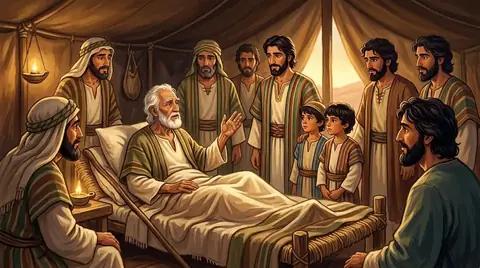 PersonLeviJacob's third son by Leah, and father of the tribe of priests and Levites. With Simeon he massacred the men of Shechem…
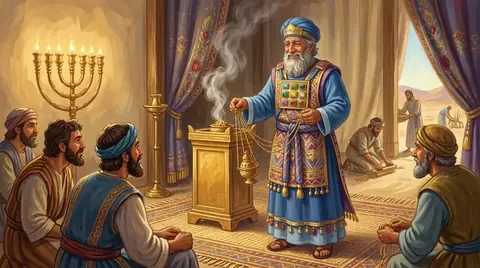 PersonAaronMoses' older brother and Israel's first high priest. He spoke for Moses before Pharaoh and served God at the tabernacle…
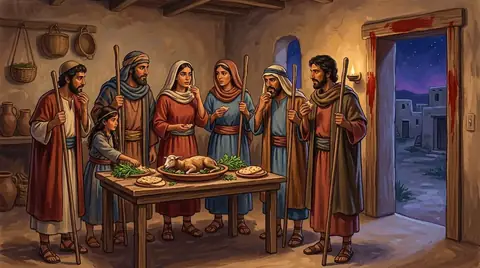 FeastPassoverThe yearly feast remembering the night God rescued Israel from Egypt, when death passed over every house marked with a…
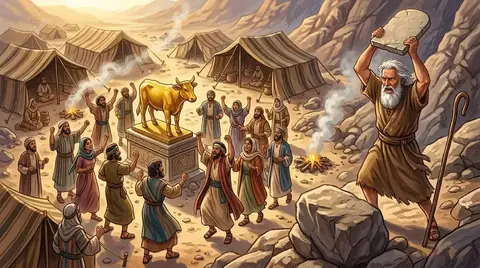 IdolThe golden calfThe image of a young bull that Aaron made at Sinai while Moses was on the mountain, and that Israel worshipped as the…
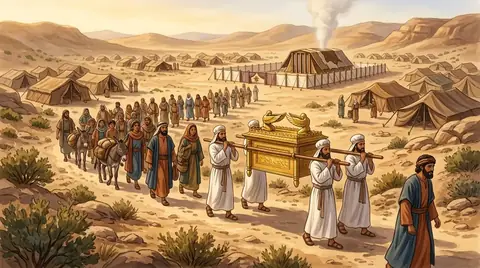 Thing · WorshipThe ark of the covenantThe gold-covered chest that held the Ten Commandments and stood in the Most Holy Place. God promised to meet with…
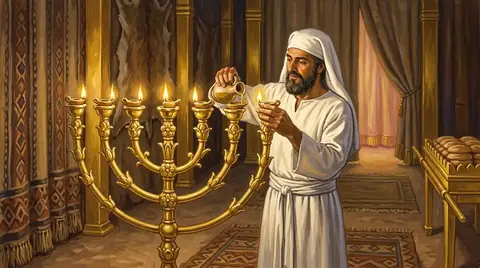 Thing · SymbolThe lampstandsThe seven-branched golden lampstand lit the Holy Place of the tabernacle. In Zechariah and Revelation lampstands stand…
 Person · KingDavidThe shepherd boy who killed Goliath and became Israel's greatest king, "a man after God's own heart". He wrote many…
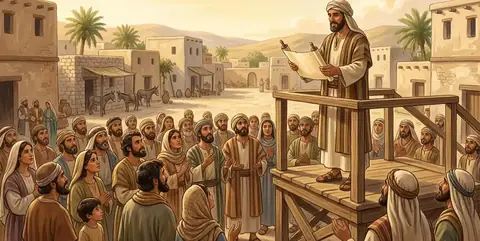 PersonEzraA priest and scribe who led a second group of exiles back from Babylon, taught the people God's law and read it to them…
Written for this app in its own words, from the Bible, with the facts checked against Bible dictionaries and encyclopedias: Easton's, Smith's, Fausset's, ISBE, Holman, the New Bible Dictionary, Vine's and the Thompson Chain topics.
