
Custom · Law
Levirate marriage
From the Latin levir, a husband's brother
The law that when a man died leaving no son, his brother was expected to marry her, and their first son would bear the name of the dead man and take over his land.
- Law
- Deuteronomy 25:5–10
- Examples
- Judah's sons and Tamar (Genesis 38); Boaz and Ruth (Ruth 4)
- In the Gospels
- The Sadducees' question about seven brothers (Matthew 22:23–33)
What it was
In Israel a family's land was its share in the Promised Land, and a man's name lived on in his sons. If a man died with no son, both were in danger of being lost. So the law said that his brother should take the widow, and the first son born would count as the dead man's, to carry his name and take his land (Deuteronomy 25:5–6). A brother who refused was brought before the elders; the widow pulled off his sandal and spat in his face, and his family was known as "the house of him that hath his shoe loosed" (Deuteronomy 25:7–10).
In the Bible
The custom was older than the law. When Judah's eldest son died, Judah told the next, Onan, to raise up a child for his brother; Onan refused in secret and God struck him dead (Genesis 38:8–10). Tamar, the widow, later tricked Judah himself into fathering twins, one of whom was an ancestor of David (Genesis 38; Ruth 4:18–22). The book of Ruth turns on the same duty: Boaz married the widow Ruth to keep the name of her dead husband on his land, after a nearer kinsman had handed over his sandal (Ruth 4:1–10). Their great-grandson was David.
The Sadducees' question
The Sadducees, who denied the resurrection, put a riddle to Jesus: seven brothers in turn married the same woman under this law; whose wife will she be at the resurrection? Jesus answered that they knew neither the Scriptures nor God's power. In the resurrection people do not marry, and God, who called himself the God of Abraham long after Abraham died, "is not the God of the dead, but of the living" (Matthew 22:23–33).
Key verses
- Deuteronomy 25:5–10
If brethren dwell together, and one of them die, and have no child, the wife of the dead shall not marry without unto a stranger: her husband’s brother shall go in unto her, and take her to him to wife, and perform the duty of an husband’s brother unto her. And it shall be, that the firstborn which she beareth shall succeed in the name of his brother which is dead, that his name be not put out of Israel. And if the man like not to take his brother’s wife, then let his brother’s wife go up to the gate unto the elders, and say, My husband’s brother refuseth to raise up unto his brother a name in Israel, he will not perform the duty of my husband’s brother. …
- Genesis 38:8
And Judah said unto Onan, Go in unto thy brother’s wife, and marry her, and raise up seed to thy brother.
- Ruth 4:5–10
Then said Boaz, What day thou buyest the field of the hand of Naomi, thou must buy it also of Ruth the Moabitess, the wife of the dead, to raise up the name of the dead upon his inheritance. And the kinsman said, I cannot redeem it for myself, lest I mar mine own inheritance: redeem thou my right to thyself; for I cannot redeem it. Now this was the manner in former time in Israel concerning redeeming and concerning changing, for to confirm all things; a man plucked off his shoe, and gave it to his neighbour: and this was a testimony in Israel. …
- Matthew 22:24–32
Saying, Master, Moses said, If a man die, having no children, his brother shall marry his wife, and raise up seed unto his brother. Now there were with us seven brethren: and the first, when he had married a wife, deceased, and, having no issue, left his wife unto his brother: Likewise the second also, and the third, unto the seventh. …
Read next
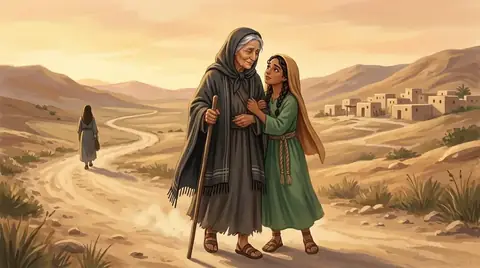 PersonRuthA young widow from Moab who left her own land to stay with her mother-in-law Naomi and trust Israel's God. She married…
 PersonJudahJacob's fourth son, who became leader among his brothers and the father of Israel's royal tribe. David, the kings of…
 Person · KingDavidThe shepherd boy who killed Goliath and became Israel's greatest king, "a man after God's own heart". He wrote many…
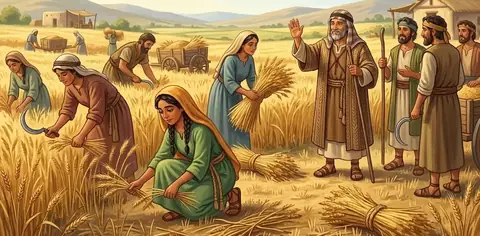 PersonBoazA wealthy farmer of Bethlehem who married Ruth, the Moabite widow, as her kinsman-redeemer. Their great-grandson was…
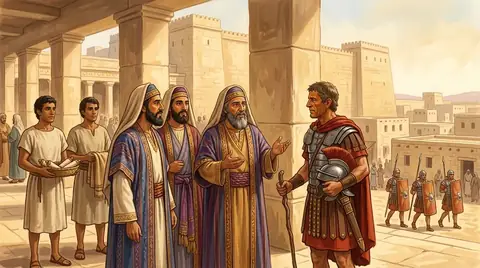 Group · Jewish partySadduceesThe wealthy priestly party that ran the temple in Jesus' day. They held only to the written Law, denied any…
 Person · The Son of GodJesus ChristThe Son of God, born of the virgin Mary, who lived a sinless life, died on a cross for the sins of the world and rose…
 PersonAbrahamThe man God called out of Ur to a land he had never seen, promising him a people and a blessing for the whole world. He…
Written for this app in its own words, from the Bible, with the facts checked against Bible dictionaries and encyclopedias: Easton's, Smith's, Fausset's, ISBE, Holman, the New Bible Dictionary, Vine's and the Thompson Chain topics.
