
Custom · War
Hough
hock
To hamstring an animal by cutting the tendon above the hoof of the back legs, so that it could never run again. Joshua and David did this to the war horses they captured, by God's command.
- Also called
- Houghing; hamstringing
- See also
- Horse, Chariot
To hough a horse was to cut the great sinew at the back of its hind leg. The animal could still live, but it could never pull a chariot or carry a rider into battle.
When the northern kings gathered against Israel at the waters of Merom, with horses and chariots "very many", God told Joshua, "thou shalt hough their horses, and burn their chariots with fire", and he did (Joshua 11:6, 9). David, after defeating Hadadezer of Zobah, houghed most of the chariot horses, keeping enough for a hundred chariots (2 Samuel 8:4; 1 Chronicles 18:4).
The reason lay in God's law: Israel's king was not to "multiply horses" (Deuteronomy 17:16). Israel was not to trust in cavalry like the nations. "Some trust in chariots, and some in horses: but we will remember the name of the LORD our God" (Psalms 20:7). Jacob also blamed Simeon and Levi because in their anger they "digged down a wall", which can be read as houghing an ox (Genesis 49:6).
Key verses
- Joshua 11:6
And the Lord said unto Joshua, Be not afraid because of them: for to morrow about this time will I deliver them up all slain before Israel: thou shalt hough their horses, and burn their chariots with fire.
- 2 Samuel 8:4
And David took from him a thousand chariots, and seven hundred horsemen, and twenty thousand footmen: and David houghed all the chariot horses, but reserved of them for an hundred chariots.
- Deuteronomy 17:16
But he shall not multiply horses to himself, nor cause the people to return to Egypt, to the end that he should multiply horses: forasmuch as the Lord hath said unto you, Ye shall henceforth return no more that way.
- Psalms 20:7
Some trust in chariots, and some in horses: but we will remember the name of the Lord our God.
Read next
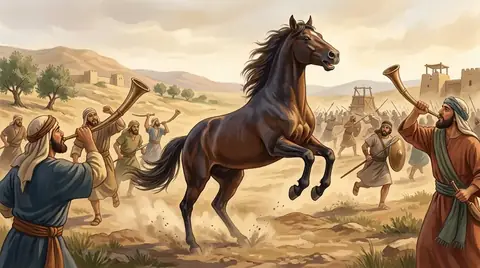 AnimalHorseIn the Bible the horse is nearly always an animal of war, pulling chariots or carrying soldiers. Israel's kings were…
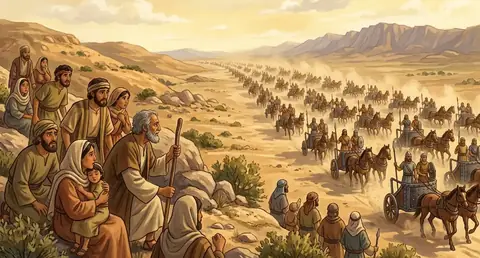 Thing · WarChariotA light two-wheeled car drawn by horses, the tank of the ancient world. Pharaoh's chariots were drowned in the Red Sea…
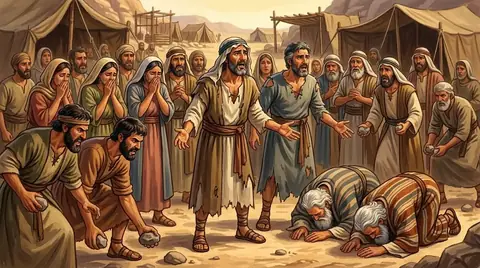 PersonJoshuaMoses' helper who took over from him and led Israel across the Jordan into the Promised Land. He fought the wars of…
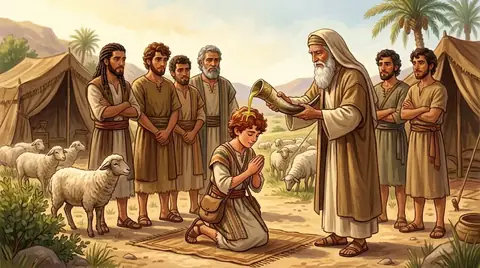 Person · KingDavidThe shepherd boy who killed Goliath and became Israel's greatest king, "a man after God's own heart". He wrote many…
Written for this app in its own words, from the Bible, with the facts checked against Bible dictionaries and encyclopedias: Easton's, Smith's, Fausset's, ISBE, Holman, the New Bible Dictionary, Vine's and the Thompson Chain topics.
