
Nation
Hebrews
HEE-broozAbraham's people, as foreigners called them · probably from Eber, his ancestor
The oldest name for the people of Israel, used mostly by outsiders such as the Egyptians and Philistines, or by Israelites speaking to them. Abraham is the first person called a Hebrew.
- Meaning
- Perhaps "the one from beyond" the river, or a descendant of Eber (Genesis 10:21)
- First used of
- Abraham, "Abram the Hebrew" (Genesis 14:13)
- Language
- Hebrew, the tongue of the Old Testament
- In the New Testament
- Jews of Hebrew speech and ancestry (Acts 6:1; 2 Corinthians 11:22; Philippians 3:5)
In the Old Testament
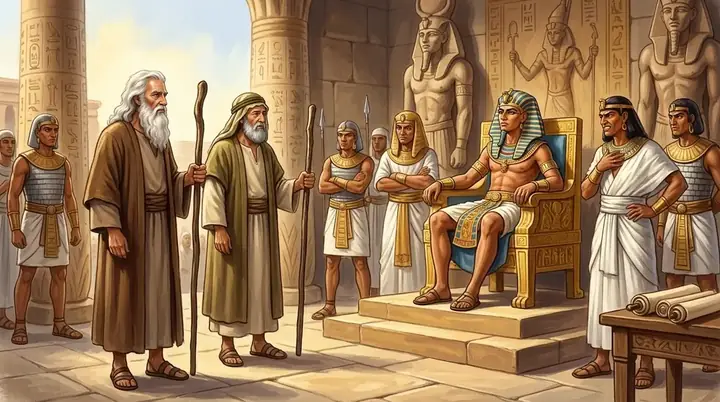
The name first appears when a fugitive tells "Abram the Hebrew" that Lot has been captured (Genesis 14:13). In Egypt it is the word the Egyptians use for Joseph and his family: Potiphar's wife complains of "an Hebrew", Joseph says he was stolen "out of the land of the Hebrews", and the Egyptians would not eat with Hebrews (Genesis 39:14; Genesis 40:15; Genesis 43:32). The midwives who feared God were "the Hebrew midwives", and Pharaoh's daughter knew the baby in the basket was "one of the Hebrews' children" (Exodus 1:15; Exodus 2:6). Moses was sent to Pharaoh in the name of "the LORD God of the Hebrews" (Exodus 3:18; Exodus 9:1). Later the Philistines called their enemies Hebrews (1 Samuel 4:6; 1 Samuel 14:11), and the law about freeing a "Hebrew servant" after six years used the word for a fellow Israelite (Exodus 21:2; Jeremiah 34:9). Jonah told the sailors, "I am an Hebrew; and I fear the LORD, the God of heaven" (Jonah 1:9).
In the New Testament
By Jesus' day the people were called Jews, and "Hebrew" marked language and heritage. The inscription on the cross was written in Hebrew, Greek and Latin (Luke 23:38; John 19:20). In the first church the "Hebrews" were the Jewish believers who spoke Aramaic, as distinct from the Greek-speaking "Grecians" (Acts 6:1). Paul, defending his credentials, called himself "an Hebrew of the Hebrews" (Philippians 3:5; 2 Corinthians 11:22). The letter to the Hebrews was written to Jewish Christians tempted to go back (Hebrews book). See Hebrews, Israelites and Jews.
Key verses
- Genesis 14:13
And there came one that had escaped, and told Abram the Hebrew; for he dwelt in the plain of Mamre the Amorite, brother of Eshcol, and brother of Aner: and these were confederate with Abram.
- Exodus 3:18
And they shall hearken to thy voice: and thou shalt come, thou and the elders of Israel, unto the king of Egypt, and ye shall say unto him, The Lord God of the Hebrews hath met with us: and now let us go, we beseech thee, three days’ journey into the wilderness, that we may sacrifice to the Lord our God.
- Jonah 1:9
And he said unto them, I am an Hebrew; and I fear the Lord, the God of heaven, which hath made the sea and the dry land.
- Acts 6:1
And in those days, when the number of the disciples was multiplied, there arose a murmuring of the Grecians against the Hebrews, because their widows were neglected in the daily ministration.
- Philippians 3:5
Circumcised the eighth day, of the stock of Israel, of the tribe of Benjamin, an Hebrew of the Hebrews; as touching the law, a Pharisee;
Mentioned in 37 verses
- Genesis 6
- Exodus 14
- Deuteronomy 1
- 1 Samuel 8
- Jeremiah 2
- Jonah 1
- Luke 1
- Acts 1
- 2 Corinthians 1
- Philippians 1
- Hebrews 1
Read next
 PersonAbrahamThe man God called out of Ur to a land he had never seen, promising him a people and a blessing for the whole world. He…
 PersonPaulA Pharisee who hated the church until the risen Jesus met him on the road to Damascus. He became the apostle to the…BookHebrews (book)A letter to Jewish Christians tempted to go back to the old ways. It shows that Jesus is greater than angels, Moses and…NationHebrews, Israelites and JewsThree names for the one people God chose. Hebrews is what outsiders called them from Abraham on; Israelites, the sons…
Written for this app in its own words, from the Bible, with the facts checked against Bible dictionaries and encyclopedias: Easton's, Smith's, Fausset's, ISBE, Holman, the New Bible Dictionary, Vine's and the Thompson Chain topics. People and places: STEPBible.org (TIPNR), CC BY 4.0; where a place is today and its photo: OpenBible.info, CC BY 4.0.
