
Place · Memorial
Galeed
GAL-ee-edOld Testament · the time of Jacob, about 1920 BC · in Gilead · "heap of witness"
The heap of stones Jacob and Laban piled up in the hills of Gilead as a witness to their peace treaty. Jacob gave it a Hebrew name and Laban an Aramaic one, both meaning "heap of witness".
- Where
- The hill country of Gilead, east of the Jordan
- Also called
- Jegar-sahadutha (Laban's name); Mizpah
- Meaning
- Heap of witness
What happened
After twenty years working for his uncle Laban, Jacob slipped away with his wives, children and flocks. Laban chased him for seven days and caught up with him in the hills of Gilead. God had warned Laban in a dream not to harm Jacob, so after angry words the two men made a covenant (Genesis 31:22–44).
Jacob set up a stone as a pillar, and their relatives gathered stones into a heap and ate a meal on it. Laban called it Jegar-sahadutha, and Jacob called it Galeed (Genesis 31:45–47). Both names mean "heap of witness": one in Aramaic, Laban's language, and one in Hebrew, the language of Jacob's family in Canaan.
A boundary and a prayer
The heap marked a line neither man would cross to harm the other. It was also called Mizpah, "watchtower", for Laban said, "The LORD watch between me and thee, when we are absent one from another" (Genesis 31:49). Those words, first spoken by two men who did not trust each other, have since become a loving prayer between friends apart.
Key verses
- Genesis 31:44–49
Now therefore come thou, let us make a covenant, I and thou; and let it be for a witness between me and thee. And Jacob took a stone, and set it up for a pillar. And Jacob said unto his brethren, Gather stones; and they took stones, and made an heap: and they did eat there upon the heap. …
- Genesis 31:52
This heap be witness, and this pillar be witness, that I will not pass over this heap to thee, and that thou shalt not pass over this heap and this pillar unto me, for harm.
Read next
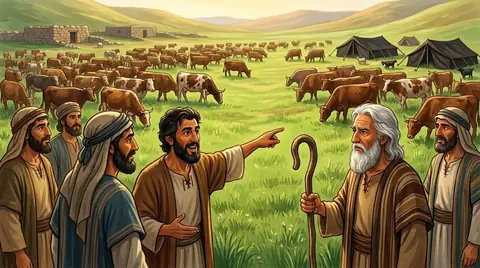 Place · RegionGileadThe wooded hill country east of the Jordan, famous for its flocks, its healing balm and its fighting men. Reuben, Gad…
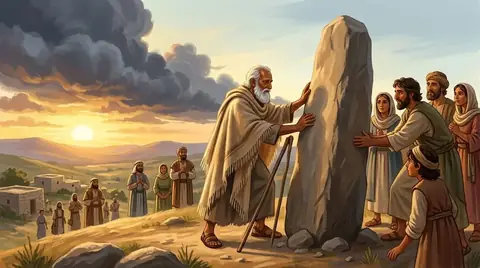 PlaceMizpahA town of Benjamin where Israel gathered in times of crisis: Samuel prayed there and won the victory of Ebenezer, Saul…
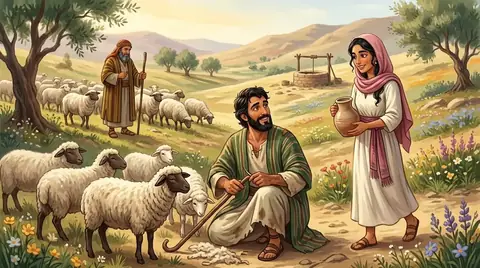 PersonLabanRebekah's brother in Haran, the father of Leah and Rachel. He took Jacob in, tricked him into marrying both daughters…
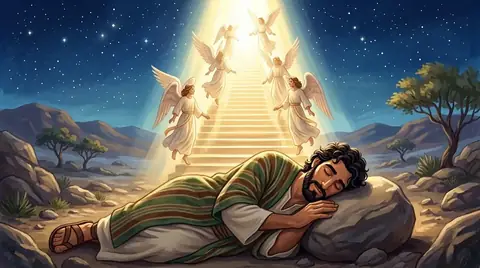 PersonJacobIsaac's younger twin son, who won his brother's birthright and blessing by cunning, was changed by God, and was renamed…
Written for this app in its own words, from the Bible, with the facts checked against Bible dictionaries and encyclopedias: Easton's, Smith's, Fausset's, ISBE, Holman, the New Bible Dictionary, Vine's and the Thompson Chain topics.
