
Place · Altar
Ed
Old Testament · about 1400 BC · "witness" · an altar by the Jordan
The name the eastern tribes gave to the great altar they built by the Jordan. It was not for sacrifice but a witness that they, too, belonged to the LORD and to Israel.
- Built by
- Reuben, Gad and half the tribe of Manasseh
- Where
- By the Jordan, at the river crossings; which bank isn't certain
- Meaning
- Witness
The altar
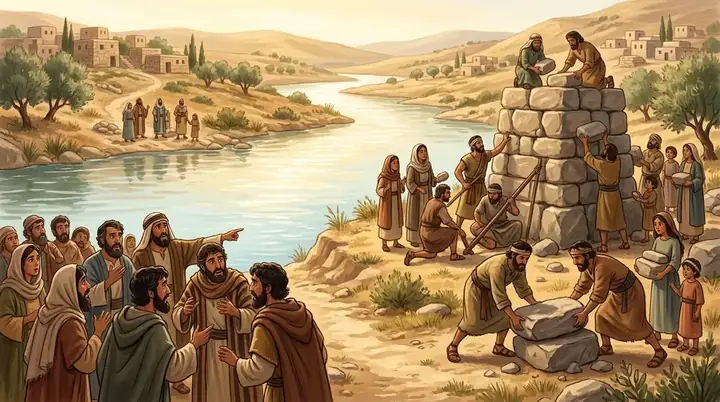
After the conquest, Joshua sent the fighting men of Reuben, Gad and half of Manasseh home across the Jordan to the land they had been given in Gilead (Joshua 22:1–9). On the way, by the river, they built "a great altar to see to" (Joshua 22:10).
Nearly a war
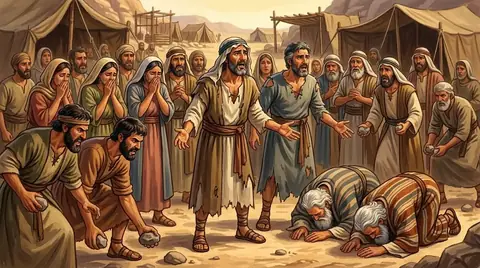
The other tribes heard of it and gathered at Shiloh to fight. Building a second altar looked like turning from the LORD, who had one place of sacrifice. They sent Phinehas the priest and ten princes to ask why. The eastern tribes answered, "The LORD God of gods, he knoweth". They had not built it for offerings. They feared that one day the tribes west of the river would tell their children, "Ye have no part in the LORD". The altar was a copy, to show that they worshipped the same God at the same altar (Joshua 22:11–29).
Witness
Phinehas and the princes were satisfied, and war was avoided. The eastern tribes named the altar Ed: "for it shall be a witness between us that the LORD is God" (Joshua 22:30–34). The story shows the wisdom of asking before attacking, and the value of signs that remind God's people they are one.
Key verses
- Joshua 22:10
And when they came unto the borders of Jordan, that are in the land of Canaan, the children of Reuben and the children of Gad and the half tribe of Manasseh built there an altar by Jordan, a great altar to see to.
- Joshua 22:26–27
Therefore we said, Let us now prepare to build us an altar, not for burnt offering, nor for sacrifice: But that it may be a witness between us, and you, and our generations after us, that we might do the service of the Lord before him with our burnt offerings, and with our sacrifices, and with our peace offerings; that your children may not say to our children in time to come, Ye have no part in the Lord.
- Joshua 22:34
And the children of Reuben and the children of Gad called the altar Ed: for it shall be a witness between us that the Lord is God.
Read next
 Person · TribeReubenJacob's firstborn, who lost the rights of the eldest by sleeping with his father's concubine. He tried to save Joseph…
 Person · TribeGadJacob's seventh son, by Leah's maid Zilpah, and the warlike tribe named after him that settled east of the Jordan. A…
 Person · TribeManassehJoseph's elder son, adopted by Jacob as a tribe of Israel, whose land straddled the Jordan. Also the longest-reigning…Place · RiverJordanThe river of the Bible: Israel crossed it on dry ground into the promised land, Elijah and Elisha parted it, Naaman…
 PersonJoshuaMoses' helper who took over from him and led Israel across the Jordan into the Promised Land. He fought the wars of…Place · RegionGileadThe wooded hill country east of the Jordan, famous for its flocks, its healing balm and its fighting men. Reuben, Gad…
 Place · TownShilohThe town in the hills of Ephraim where the tabernacle stood for over three hundred years, from Joshua to Samuel. Hannah…PersonPhinehasThe grandson of Aaron whose zeal for God stopped a plague at Shittim. God rewarded him with an everlasting priesthood.…
Written for this app in its own words, from the Bible, with the facts checked against Bible dictionaries and encyclopedias: Easton's, Smith's, Fausset's, ISBE, Holman, the New Bible Dictionary, Vine's and the Thompson Chain topics.
