
Custom · Home
Doorposts (the mezuzah)
me-ZOO-zah
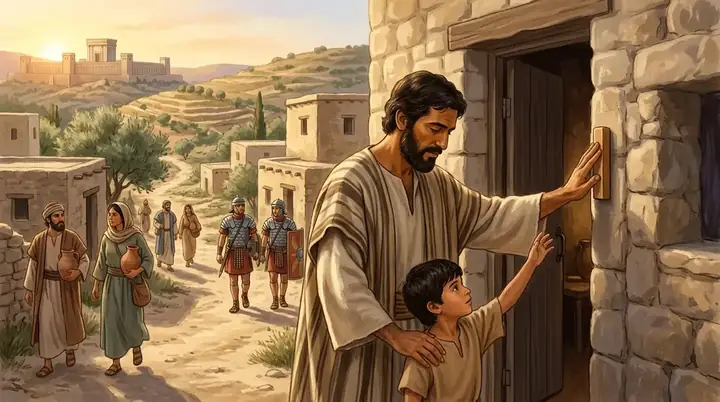
Moses commanded Israel to write God's words on the doorposts of their houses and on their gates. Jewish families later obeyed by nailing a little case with the verses inside to the doorframe, and touched it on every passing through the door.
- Where
- Deuteronomy 6:9; Deuteronomy 11:20
- Hebrew
- Mezuzah means "doorpost"; later the name passed to the little case
- Inside the case
- Deuteronomy 6:4–9 and Deuteronomy 11:13–21, written on a tiny parchment
The command
After giving the great commandment, "Hear, O Israel: The LORD our God is one LORD", Moses told the people to keep these words in their hearts, teach them to their children, bind them on their hands and foreheads, and write them "upon the posts of thy house, and on thy gates" (Deuteronomy 6:4–9; Deuteronomy 11:20). God's word was to meet them at every going out and coming in.
How it was kept
Later Jews took the words exactly. A scribe wrote the two passages on a small roll of parchment, which was put in a case of wood or metal and nailed slantwise to the right-hand doorpost. On the outside was written Shaddai, "Almighty". People touched the case and kissed their fingers as they passed through the door. Jewish homes still have a mezuzah today. In Jesus' day the Pharisees made a show of such things, and he rebuked them for wearing wide phylacteries while missing the heart of the law (Matthew 23:5).
What it means
The doorposts had already been marked once, with the blood of the Passover lamb (Exodus 12:22). Now they carried God's words. The point was never the box but the memory: a home is to belong to God, and his word is to be the first thing seen on leaving and on coming back.
Key verses
- Deuteronomy 6:4–9
Hear, O Israel: The Lord our God is one Lord: And thou shalt love the Lord thy God with all thine heart, and with all thy soul, and with all thy might. And these words, which I command thee this day, shall be in thine heart: …
- Deuteronomy 11:20
And thou shalt write them upon the door posts of thine house, and upon thy gates:
- Exodus 12:22
And ye shall take a bunch of hyssop, and dip it in the blood that is in the bason, and strike the lintel and the two side posts with the blood that is in the bason; and none of you shall go out at the door of his house until the morning.
Read next
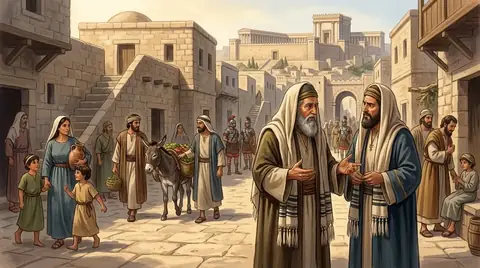 GroupPhariseesThe most exacting of the Jewish religious parties in Jesus' day, devoted to keeping the Law and the traditions added to…
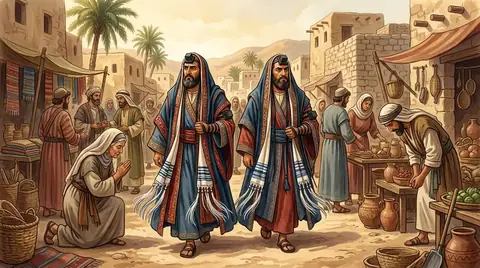 Custom · WorshipPhylacteriesSmall leather boxes holding Scripture verses, strapped to the forehead and left arm at prayer time. Jesus rebuked the…
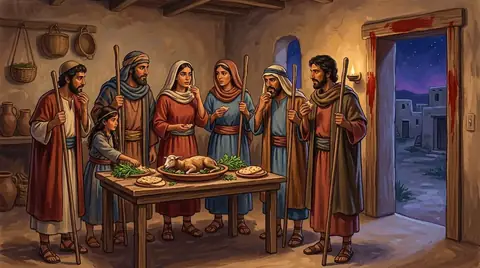 FeastPassoverThe yearly feast remembering the night God rescued Israel from Egypt, when death passed over every house marked with a…
Written for this app in its own words, from the Bible, with the facts checked against Bible dictionaries and encyclopedias: Easton's, Smith's, Fausset's, ISBE, Holman, the New Bible Dictionary, Vine's and the Thompson Chain topics.
