
Idol · Goddess
Diana
dy-AN-aGreek Artemis · her temple at Ephesus was one of the seven wonders
The goddess of Ephesus, whose huge temple drew pilgrims and trade from all Asia. When Paul's preaching hurt the silversmiths' business, the city rioted shouting her name for two hours.
- Where
- Acts 19:23–41
- Also called
- Artemis (Greek); the Ephesian Diana was a mother-goddess of fertility, not the Roman huntress
- Her temple
- About 342 ft by 164 ft (104 m by 50 m), with over a hundred marble columns
Who she was
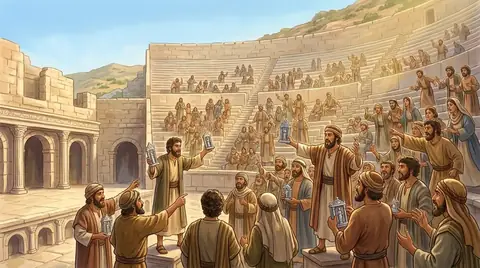
The Romans called her Diana and the Greeks Artemis, but the Diana of Ephesus was older than either: an eastern mother-goddess of fertility, shown as a many-breasted figure. Her image was said to have fallen from the sky (Acts 19:35). Her temple, built of gleaming marble on a forest of columns, stood outside the city wall and was counted among the seven wonders of the world. It was also a bank, where kings kept their treasure, and a place of refuge. Pilgrims bought little silver shrines of the goddess to take home.
The riot
Paul spent about three years in Ephesus, and so many turned from idols that the trade in shrines fell off. A silversmith named Demetrius gathered the craftsmen and warned them that both their living and the honour of the goddess were at stake. The crowd poured into the theatre, which seated some 25,000, and for two hours shouted "Great is Diana of the Ephesians" (Acts 19:28–34). Paul wanted to go in and speak, but his friends held him back. At last the town clerk calmed the mob, pointing out that the courts were open and that the city could be charged with riot (Acts 19:35–41).
What it means
Demetrius saw clearly what was at stake: "the temple of the great goddess Diana should be despised". The gospel had not attacked the idol with riots; it had simply made people stop needing her. The temple lasted until the Goths burned it in AD 262, and today a single column stands in a marsh. The church Paul founded received two New Testament letters and a message from the risen Christ (Revelation 2:1–7).
Key verses
- Acts 19:24–28
For a certain man named Demetrius, a silversmith, which made silver shrines for Diana, brought no small gain unto the craftsmen; Whom he called together with the workmen of like occupation, and said, Sirs, ye know that by this craft we have our wealth. Moreover ye see and hear, that not alone at Ephesus, but almost throughout all Asia, this Paul hath persuaded and turned away much people, saying that they be no gods, which are made with hands: …
- Acts 19:35
And when the townclerk had appeased the people, he said, Ye men of Ephesus, what man is there that knoweth not how that the city of the Ephesians is a worshipper of the great goddess Diana, and of the image which fell down from Jupiter?
- Acts 19:40
For we are in danger to be called in question for this day’s uproar, there being no cause whereby we may give an account of this concourse.
On the map
Read next
Written for this app in its own words, from the Bible, with the facts checked against Bible dictionaries and encyclopedias: Easton's, Smith's, Fausset's, ISBE, Holman, the New Bible Dictionary, Vine's and the Thompson Chain topics.
