
Symbol · Custom
The crown
The circlet worn by kings and queens, by the high priest, by brides and by winners of the games. The Bible makes it a picture of God's reward: a crown of life that does not fade.
- Worn by
- Kings (2 Samuel 1:10), queens (Esther 2:17), the high priest (Exodus 29:6), bridegrooms (Song of Songs 3:11), athletes (1 Corinthians 9:25)
- Promised
- A crown of righteousness (2 Timothy 4:8), of life (James 1:12), of glory (1 Peter 5:4)
- Jesus
- Crowned with thorns (Matthew 27:29), then "with glory and honour" (Hebrews 2:9), with many crowns (Revelation 19:12)
What it was
Several Hebrew words lie behind the English. The plate of pure gold on the high priest's turban, engraved "Holiness to the LORD", was his crown (Exodus 29:6; Exodus 39:30). The same word is used for the circlet Saul wore in battle and the one placed on the boy king Joash (2 Samuel 1:10; 2 Kings 11:12). Kings' crowns were of gold and could be heavy with jewels: David took one from the king of the Ammonites that weighed a talent (2 Samuel 12:30). Persian queens wore a tall crown (Esther 2:17). But a crown was not only for royalty. Bridegrooms wore a garland on their wedding day (Song of Songs 3:11), guests at feasts were crowned with flowers, and at the Greek games the winner received a wreath of leaves (1 Corinthians 9:25). The grey head is a crown of glory to the old (Proverbs 16:31), and a good wife is a crown to her husband (Proverbs 12:4).
The crown of thorns
The soldiers who mocked Jesus twisted thorns into a crown and pressed it on his head, with a reed for a sceptre, and bowed to him as King of the Jews (Matthew 27:29). It was meant as a joke, and it was the truth. Hebrews says that the one who was made a little lower than the angels for the suffering of death is now "crowned with glory and honour" (Hebrews 2:9), and John saw him ride out with many crowns on his head (Revelation 19:12).
The crown promised
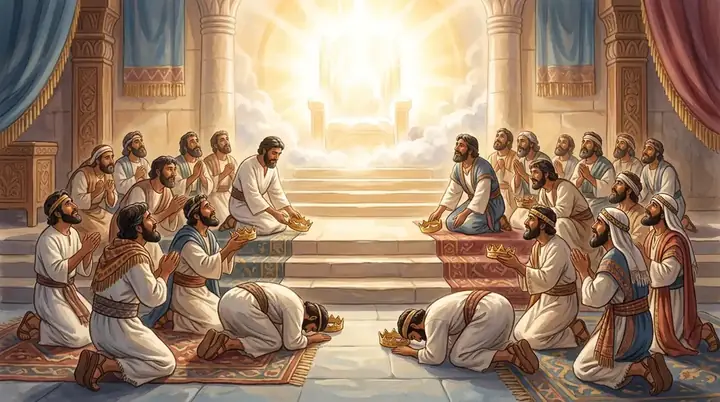
The apostles took the athlete's wreath and the king's circlet and made them a promise for the faithful. Paul, near the end of his life, looked for "a crown of righteousness" from the Lord, the righteous judge (2 Timothy 4:8). James and Jesus both promise "the crown of life" to those who endure under trial and are faithful unto death (James 1:12; Revelation 2:10). Peter promises shepherds of God's flock a crown of glory that does not fade (1 Peter 5:4). An athlete's wreath withered in a week; these do not. And in heaven the twenty-four elders take their crowns off and lay them before the throne (Revelation 4:10): every honour the saved receive goes back to the one who gave it.
Key verses
- Exodus 29:6
And thou shalt put the mitre upon his head, and put the holy crown upon the mitre.
- Proverbs 16:31
The hoary head is a crown of glory, if it be found in the way of righteousness.
- Matthew 27:29
And when they had platted a crown of thorns, they put it upon his head, and a reed in his right hand: and they bowed the knee before him, and mocked him, saying, Hail, King of the Jews!
- 2 Timothy 4:8
Henceforth there is laid up for me a crown of righteousness, which the Lord, the righteous judge, shall give me at that day: and not to me only, but unto all them also that love his appearing.
- James 1:12
Blessed is the man that endureth temptation: for when he is tried, he shall receive the crown of life, which the Lord hath promised to them that love him.
- Revelation 4:10
The four and twenty elders fall down before him that sat on the throne, and worship him that liveth for ever and ever, and cast their crowns before the throne, saying,
Read next
Written for this app in its own words, from the Bible, with the facts checked against Bible dictionaries and encyclopedias: Easton's, Smith's, Fausset's, ISBE, Holman, the New Bible Dictionary, Vine's and the Thompson Chain topics.
