
Place · Worship
The Court of the Gentiles
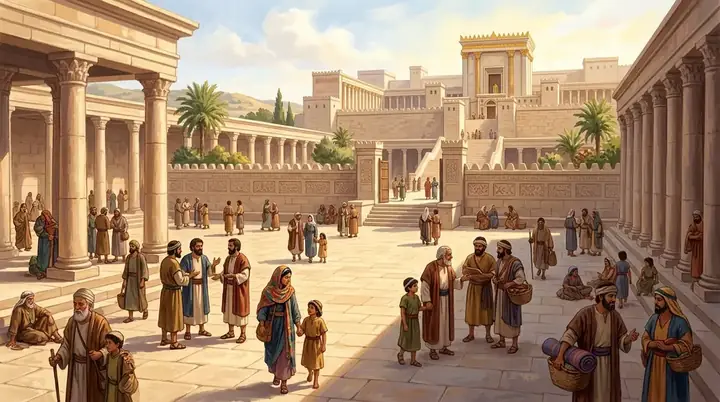
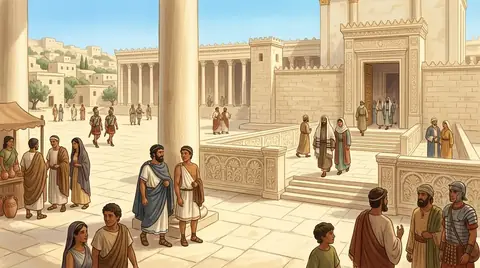
The huge outer court of Herod's temple, open to anyone. Jesus drove the traders out of it, and a wall with warning notices kept non-Jews from going further in.
- Where
- The outer part of the temple mount in Jerusalem, ringed with pillared porches
- Size
- About 35 acres (14 hectares) in all, the largest sacred enclosure of the ancient world
- In the Bible
- Mark 11:15–17; John 10:23; Acts 3:11; Acts 21:28–29
What it was
Herod the Great rebuilt the temple on a vast platform, and the greater part of that platform was a paved court open to everyone, Jew or Gentile, clean or unclean. Along its edges ran covered walks on tall marble pillars; the one on the east was called Solomon's Porch, where Jesus walked in winter (John 10:23) and where the first Christians met (Acts 3:11; Acts 5:12). The court was a marketplace too: here the sellers of oxen, sheep and doves and the money-changers set up their tables for the pilgrims.
A low stone wall ran round the inner courts, with notices in Greek and Latin warning that any foreigner who passed it would have himself to blame for his death. One of those stones has been found. This was as far as a Gentile could go, and when the Jews of Asia thought Paul had taken a Greek friend past it, the whole city rioted and he was nearly killed (Acts 21:27–31).
Jesus in the court
Twice Jesus cleared the traders out, at the beginning of his ministry (John 2:13–17) and in his last week. He overturned the tables and quoted Isaiah: God's house was to be called "of all nations the house of prayer", but they had made it "a den of thieves" (Mark 11:15–17; Isaiah 56:7). The one court where the nations could pray had been turned into a market.
What it meant
Paul, who had been nearly lynched for allegedly breaching that wall, wrote that Christ has broken down "the middle wall of partition" between Jew and Gentile and made of the two one new man (Ephesians 2:14–15). The barrier in the temple was a picture of what the cross has taken away. In Revelation the outer court is left out of the measuring, given over to the nations (Revelation 11:2).
Key verses
- Mark 11:15–17
And they come to Jerusalem: and Jesus went into the temple, and began to cast out them that sold and bought in the temple, and overthrew the tables of the moneychangers, and the seats of them that sold doves; And would not suffer that any man should carry any vessel through the temple. And he taught, saying unto them, Is it not written, My house shall be called of all nations the house of prayer? but ye have made it a den of thieves.
- John 10:23
And Jesus walked in the temple in Solomon’s porch.
- Acts 21:28
Crying out, Men of Israel, help: This is the man, that teacheth all men every where against the people, and the law, and this place: and further brought Greeks also into the temple, and hath polluted this holy place.
- Ephesians 2:14
For he is our peace, who hath made both one, and hath broken down the middle wall of partition between us;
- Revelation 11:2
But the court which is without the temple leave out, and measure it not; for it is given unto the Gentiles: and the holy city shall they tread under foot forty and two months.
Read next
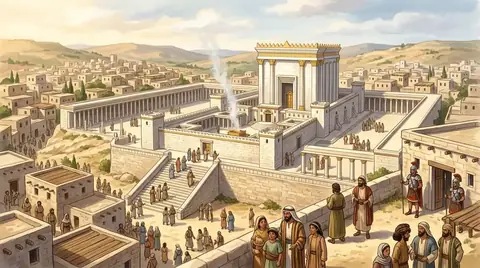 Thing · WorshipThe TempleGod's house in Jerusalem, where he was worshipped and the sacrifices offered. Solomon built it, Babylon burned it, the…
 PlaceJerusalemThe city David made his capital and where Solomon built the temple. Jesus died and rose there and the church began…
 Person · KingHerodThe name of a family of rulers under Rome. Herod the Great tried to kill the infant Jesus; his son Antipas beheaded…
 GroupGentilesEveryone who was not a Jew. Israel was kept apart from the nations, yet God had promised to bless them all through…
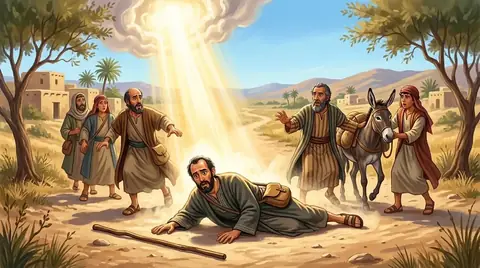 PersonPaulA Pharisee who hated the church until the risen Jesus met him on the road to Damascus. He became the apostle to the…
Written for this app in its own words, from the Bible, with the facts checked against Bible dictionaries and encyclopedias: Easton's, Smith's, Fausset's, ISBE, Holman, the New Bible Dictionary, Vine's and the Thompson Chain topics. Also: Josephus, Jewish War 5.5; Edersheim, The Temple: Its Ministry and Services.
