
Person
Bildad
BIL-dadOld Testament · the time of the patriarchs
One of Job's three friends, called "the Shuhite." He came to comfort Job, but his speeches insisted that God was punishing Job for sin, and in the end God rebuked him.
- Known for
- Three speeches to Job (Job 8; 18; 25)
- From
- Shuah, probably a people descended from Abraham and Keturah (Genesis 25:2)
Who he was
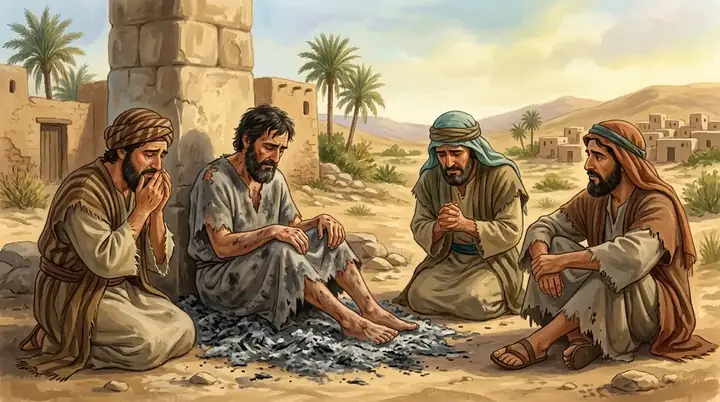
When Job lost his children, his wealth and his health, three friends came from a distance to sit with him: Eliphaz, Bildad and Zophar. For seven days they said nothing, which was the kindest thing they did (Job 2:11–13). Bildad was probably descended from Shuah, a son of Abraham by Keturah, whose family settled in Arabia.
What he said
Bildad spoke second in each round. His theme was that God is always fair, so suffering must mean sin. He even suggested that Job's children had died for their own wrongdoing, and that if Job were truly upright God would soon restore him (Job 8:3–7). His second speech paints the terrible end of the wicked, plainly meaning Job (Job 18). His third is only six verses: man is a worm, and no one can be clean before God (Job 25). He had run out of arguments.
What went wrong
Bildad's view of God was too small. He thought he could read God's judgment from a man's circumstances. At the end the LORD said to Eliphaz that he and his two friends had "not spoken of me the thing that is right," and they had to bring a sacrifice and ask Job to pray for them (Job 42:7–9). Good doctrine wrongly applied can wound a friend.
Key verses
- Job 2:11
Now when Job’s three friends heard of all this evil that was come upon him, they came every one from his own place; Eliphaz the Temanite, and Bildad the Shuhite, and Zophar the Naamathite: for they had made an appointment together to come to mourn with him and to comfort him.
- Job 8:5–7
If thou wouldest seek unto God betimes, and make thy supplication to the Almighty; If thou wert pure and upright; surely now he would awake for thee, and make the habitation of thy righteousness prosperous. Though thy beginning was small, yet thy latter end should greatly increase.
- Job 25:4–6
How then can man be justified with God? or how can he be clean that is born of a woman? Behold even to the moon, and it shineth not; yea, the stars are not pure in his sight. How much less man, that is a worm? and the son of man, which is a worm?
- Job 42:7–9
And it was so, that after the Lord had spoken these words unto Job, the Lord said to Eliphaz the Temanite, My wrath is kindled against thee, and against thy two friends: for ye have not spoken of me the thing that is right, as my servant Job hath. Therefore take unto you now seven bullocks and seven rams, and go to my servant Job, and offer up for yourselves a burnt offering; and my servant Job shall pray for you: for him will I accept: lest I deal with you after your folly, in that ye have not spoken of me the thing which is right, like my servant Job. So Eliphaz the Temanite and Bildad the Shuhite and Zophar the Naamathite went, and did according as the Lord commanded them: the Lord also accepted Job.
Mentioned in 5 verses
- Job 5
Read next

Written for this app in its own words, from the Bible, with the facts checked against Bible dictionaries and encyclopedias: Easton's, Smith's, Fausset's, ISBE, Holman, the New Bible Dictionary, Vine's and the Thompson Chain topics. People and places: STEPBible.org (TIPNR), CC BY 4.0; where a place is today and its photo: OpenBible.info, CC BY 4.0.
