
Group
Barbarians
Greek barbaros, "one whose speech sounds like bar-bar"
The Greek word for anyone who did not speak Greek, used without insult in the New Testament. The "barbarous people" of Malta were kind to Paul; in Christ there is neither Greek nor barbarian.
- Where
- Acts 28:2,4; Romans 1:14; 1 Corinthians 14:11; Colossians 3:11
- Meant
- A foreigner, someone of another tongue; not a savage
To a Greek, the world was divided into Greeks and everyone else, and everyone else was a "barbarian". The word mimicked the way foreign speech sounded, a meaningless "bar-bar". It did not mean cruel or wild; it meant "not one of us".
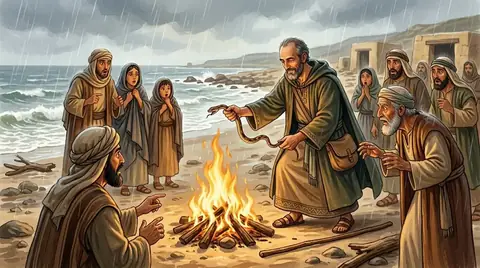
Luke uses it for the islanders of Malta, who lit a fire for the shipwrecked crew in the rain and "shewed us no little kindness" (Acts 28:2). When a viper bit Paul and he came to no harm, these same people decided he was a god (Acts 28:4–6). Paul writes that he is a debtor "both to the Greeks, and to the Barbarians", to the educated and the plain alike (Romans 1:14). He says that if two people cannot understand each other's language, each is a barbarian to the other (1 Corinthians 14:11). Best of all, he tells the Colossians that in the new man "there is neither Greek nor Jew... Barbarian, Scythian, bond nor free: but Christ is all, and in all" (Colossians 3:11). The gospel knows no outsiders.
Key verses
- Acts 28:2
And the barbarous people shewed us no little kindness: for they kindled a fire, and received us every one, because of the present rain, and because of the cold.
- Romans 1:14
I am debtor both to the Greeks, and to the Barbarians; both to the wise, and to the unwise.
- 1 Corinthians 14:11
Therefore if I know not the meaning of the voice, I shall be unto him that speaketh a barbarian, and he that speaketh shall be a barbarian unto me.
- Colossians 3:11
Where there is neither Greek nor Jew, circumcision nor uncircumcision, Barbarian, Scythian, bond nor free: but Christ is all, and in all.
Read next
Written for this app in its own words, from the Bible, with the facts checked against Bible dictionaries and encyclopedias: Easton's, Smith's, Fausset's, ISBE, Holman, the New Bible Dictionary, Vine's and the Thompson Chain topics.
