
Idol
Artemis of the Ephesians
Diana in the King James Bible
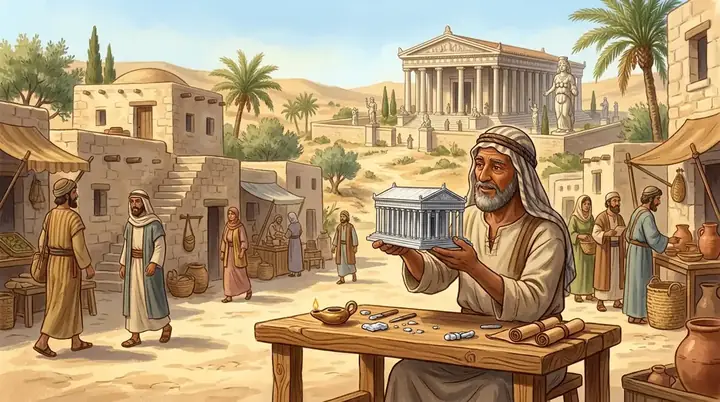
The goddess of Ephesus, whose huge temple was counted among the seven wonders of the world. When Paul's preaching hurt the trade in her silver shrines, the city rioted for two hours in her name.
- Where
- Acts 19:23–41
- Her temple
- Four times the size of the Parthenon, with over a hundred marble columns; one of the seven wonders
- Known for
- "Great is Diana of the Ephesians" (Acts 19:28)
Who she was
The Greeks worshipped Artemis as the virgin goddess of the hunt, but the Artemis of Ephesus was something older and stranger: a mother goddess of fertility, whose strange statue, covered in rows of egg-like shapes, was said to have fallen from the sky (Acts 19:35). Her temple outside the city was enormous, built of gleaming marble and crowded with pilgrims from all over Asia. It was also a bank and a place of refuge. Ephesus lived on her: the inns, the priests, the craftsmen who sold little silver models of her shrine as souvenirs and charms.
In the Bible
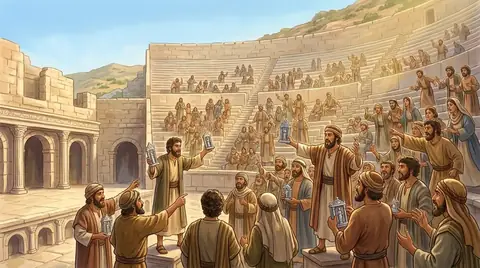
Paul preached in Ephesus for more than two years, longer than anywhere else, and so many people turned from magic and idols that a silversmith named Demetrius saw his trade collapsing. He gathered the craftsmen and told them that Paul was persuading people that gods made with hands were no gods at all, and that both their income and the goddess's honour were in danger. The crowd rushed into the theatre shouting "Great is Diana of the Ephesians", and kept it up for two hours; most of them did not know why they had come. Paul wanted to go in and face them, but his friends held him back. At last the town clerk quietened the mob, pointed out that Paul's companions had neither robbed the temple nor insulted the goddess, and sent everyone home (Acts 19:23–41).
What it means
The riot shows what the gospel does to an idol's economy. When people stop buying, the god's friends get angry. It also shows how empty the noise was: two hours of shouting, and the clerk could still ask what the complaint actually was. Within a few centuries the temple was a ruin and Ephesus a Christian city.
Key verses
- Acts 19:24–28
For a certain man named Demetrius, a silversmith, which made silver shrines for Diana, brought no small gain unto the craftsmen; Whom he called together with the workmen of like occupation, and said, Sirs, ye know that by this craft we have our wealth. Moreover ye see and hear, that not alone at Ephesus, but almost throughout all Asia, this Paul hath persuaded and turned away much people, saying that they be no gods, which are made with hands: …
- Acts 19:34–35
But when they knew that he was a Jew, all with one voice about the space of two hours cried out, Great is Diana of the Ephesians. And when the townclerk had appeased the people, he said, Ye men of Ephesus, what man is there that knoweth not how that the city of the Ephesians is a worshipper of the great goddess Diana, and of the image which fell down from Jupiter?
On the map
Read next
Written for this app in its own words, from the Bible, with the facts checked against Bible dictionaries and encyclopedias: Easton's, Smith's, Fausset's, ISBE, Holman, the New Bible Dictionary, Vine's and the Thompson Chain topics.
