
Plant · Spices
Aloes, cassia and cinnamon
Fragrant woods and barks from the East, used for perfume, anointing oil and burial
Costly scented woods, barks and gums that traders carried from Arabia, India and Africa. Cinnamon and cassia went into the holy anointing oil; aloes and myrrh wrapped the body of Jesus.
- Cinnamon and cassia
- Barks of trees of the laurel family, from Ceylon and the East; in the holy anointing oil (Exodus 30:23–24)
- Aloes
- A fragrant resinous wood, agarwood (Numbers 24:6; John 19:39)
- Calamus
- A sweet-smelling reed, also in the anointing oil
- Stacte, onycha, galbanum
- Gums that went into the holy incense (Exodus 30:34)
Where they came from
None of these grew in Israel. Cinnamon and cassia are the inner bark of related trees from Ceylon and south China; aloes is the resin-soaked wood of an eastern tree; calamus a scented reed; and the gums of the incense came from Arabia and Africa. The caravans that crossed Arabia and the ships of Tyre carried them (Ezekiel 27:19), and they were worth their weight in silver. In Revelation, cinnamon and spices are among the luxuries of fallen Babylon (Revelation 18:13).
In worship
God gave Moses a recipe for the holy anointing oil: liquid myrrh, sweet cinnamon, sweet calamus and cassia, blended in olive oil. With it the tabernacle, its furniture and the priests were anointed, and no one was to make the same mixture for himself (Exodus 30:22–33). A second recipe, for the incense burned on the golden altar, used stacte, onycha and galbanum with pure frankincense, and it too was holy and not to be copied (Exodus 30:34–38). The sweet smell set apart what belonged to God.
In daily life and poetry
The same spices scented the robes of a king (Psalms 45:8) and the garden of the Song (Song of Songs 4:14); a loose woman could also use them to tempt (Proverbs 7:17).
At the tomb
Nicodemus brought a great weight of myrrh and aloes, and he and Joseph of Arimathea bound Jesus' body in linen with the spices (John 19:39–40). It was the burial of a rich man, just as Isaiah had foretold (Isaiah 53:9). See also aloes and myrrh.
Key verses
- Exodus 30:23–24
Take thou also unto thee principal spices, of pure myrrh five hundred shekels, and of sweet cinnamon half so much, even two hundred and fifty shekels, and of sweet calamus two hundred and fifty shekels, And of cassia five hundred shekels, after the shekel of the sanctuary, and of oil olive an hin:
- Exodus 30:34
And the Lord said unto Moses, Take unto thee sweet spices, stacte, and onycha, and galbanum; these sweet spices with pure frankincense: of each shall there be a like weight:
- Psalms 45:8
All thy garments smell of myrrh, and aloes, and cassia, out of the ivory palaces, whereby they have made thee glad.
- Ezekiel 27:19
Dan also and Javan going to and fro occupied in thy fairs: bright iron, cassia, and calamus, were in thy market.
- John 19:39–40
And there came also Nicodemus, which at the first came to Jesus by night, and brought a mixture of myrrh and aloes, about an hundred pound weight. Then took they the body of Jesus, and wound it in linen clothes with the spices, as the manner of the Jews is to bury.
Read next
 Place · CityTyreThe great trading port of Phoenicia, on the coast north of Israel. Its king Hiram helped build Solomon's temple; later…
 Thing · WorshipIncenseA holy blend of sweet spices that the priest burned on the golden altar of the tabernacle at dawn and at dusk. Its…
 PersonNicodemusThe Pharisee who came to Jesus by night and was told he must be born again. He later spoke up for Jesus in the council…
 PersonJosephJacob's favourite son, sold by his brothers into Egypt, where he rose from prison to rule the land and saved his family…Plant · PerfumeAloesA costly, sweet-smelling wood from India and the Far East, used in perfumes and for wrapping the dead. Nicodemus…
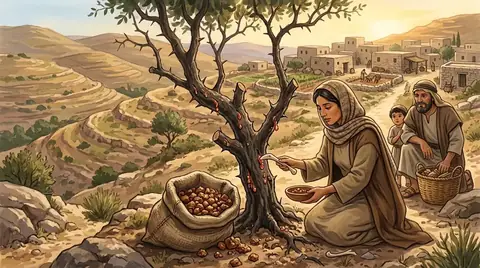 Plant · SpiceMyrrhA bitter, sweet-smelling gum from a thorny desert tree, costly and prized as perfume, medicine and for burial. The wise…
Written for this app in its own words, from the Bible, with the facts checked against Bible dictionaries and encyclopedias: Easton's, Smith's, Fausset's, ISBE, Holman, the New Bible Dictionary, Vine's and the Thompson Chain topics.
