
Person
Ziba
ZY-buhOld Testament · about 1000 BC
A servant of King Saul's family. He told David about Jonathan's lame son Mephibosheth, then later lied about his master to win his master's land.
- Served
- The house of Saul, then Mephibosheth for King David
- Household
- Fifteen sons and twenty servants (2 Samuel 9:10)
- Known for
- Slandering Mephibosheth during Absalom's revolt
His story
When David was settled as king, he wanted to show kindness to anyone left from Saul's family, for the sake of his friend Jonathan. Ziba, who had been a servant in Saul's house, told him that Jonathan had a son, Mephibosheth, who was lame in both feet (2 Samuel 9:2–4). David gave Mephibosheth all of Saul's land and a place at the royal table, and put Ziba, with his sons and servants, in charge of farming it for him (2 Samuel 9:9–11).
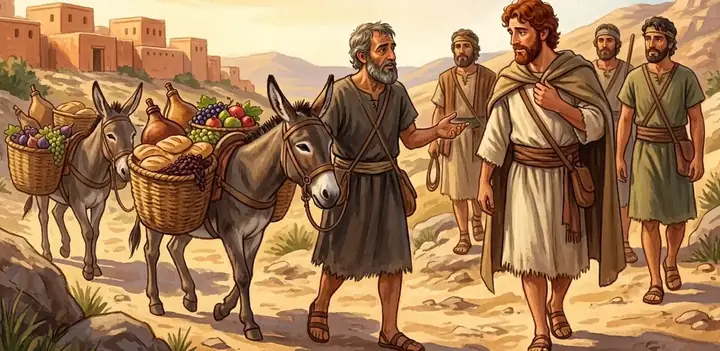
Years later, when Absalom rebelled and David fled Jerusalem, Ziba met the king with two donkeys loaded with bread, raisins, fruit and wine. Asked where his master was, Ziba said Mephibosheth had stayed behind, hoping Israel would now give him back his grandfather's kingdom. In the heat of the moment David gave Ziba everything that had been Mephibosheth's (2 Samuel 16:1–4).
The truth comes out
When David came back, Mephibosheth met him unwashed and in mourning. He said Ziba had deceived him and left him behind, and had slandered him to the king. David, unsure whom to believe, ordered the land to be divided between them. Mephibosheth answered that Ziba could have it all, since the king had come home safely (2 Samuel 19:24–30).
What to learn
Ziba's gifts were real, but they came with a lie attached. His story is a warning against judging a matter after hearing only one side (Proverbs 18:17), and against using kindness to get ahead.
Key verses
- 2 Samuel 9:9–11
Then the king called to Ziba, Saul’s servant, and said unto him, I have given unto thy master’s son all that pertained to Saul and to all his house. Thou therefore, and thy sons, and thy servants, shall till the land for him, and thou shalt bring in the fruits, that thy master’s son may have food to eat: but Mephibosheth thy master’s son shall eat bread alway at my table. Now Ziba had fifteen sons and twenty servants. Then said Ziba unto the king, According to all that my lord the king hath commanded his servant, so shall thy servant do. As for Mephibosheth, said the king, he shall eat at my table, as one of the king’s sons.
- 2 Samuel 16:1–4
And when David was a little past the top of the hill, behold, Ziba the servant of Mephibosheth met him, with a couple of asses saddled, and upon them two hundred loaves of bread, and an hundred bunches of raisins, and an hundred of summer fruits, and a bottle of wine. And the king said unto Ziba, What meanest thou by these? And Ziba said, The asses be for the king’s household to ride on; and the bread and summer fruit for the young men to eat; and the wine, that such as be faint in the wilderness may drink. And the king said, And where is thy master’s son? And Ziba said unto the king, Behold, he abideth at Jerusalem: for he said, To day shall the house of Israel restore me the kingdom of my father. …
- 2 Samuel 19:24–30
And Mephibosheth the son of Saul came down to meet the king, and had neither dressed his feet, nor trimmed his beard, nor washed his clothes, from the day the king departed until the day he came again in peace. And it came to pass, when he was come to Jerusalem to meet the king, that the king said unto him, Wherefore wentest not thou with me, Mephibosheth? And he answered, My lord, O king, my servant deceived me: for thy servant said, I will saddle me an ass, that I may ride thereon, and go to the king; because thy servant is lame. …
- Proverbs 18:17
He that is first in his own cause seemeth just; but his neighbour cometh and searcheth him.
Mentioned in 13 verses
- 2 Samuel 13
Read next
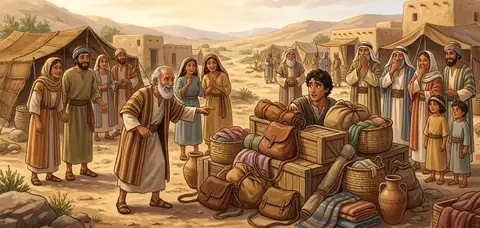 Person · KingSaulIsrael's first king, a tall Benjamite chosen when the people demanded a king like the nations. He began humbly and won…
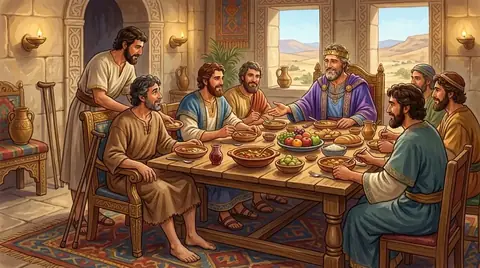 PersonMephiboshethJonathan's son, lame in both feet since a childhood fall, whom David sought out for his father's sake, gave back his…
 Person · KingDavidThe shepherd boy who killed Goliath and became Israel's greatest king, "a man after God's own heart". He wrote many…
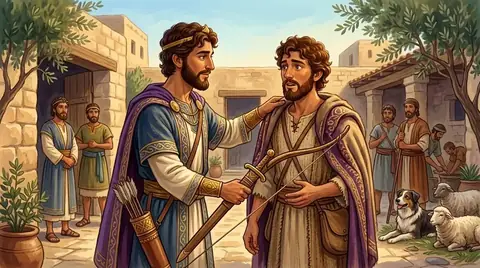 PersonJonathanSaul's eldest son and David's closest friend. A brave soldier who climbed a cliff to rout the Philistines, he gave up…
 PersonAbsalomDavid's handsome third son, who murdered his brother Amnon, won the hearts of Israel and rose in rebellion against his…
Written for this app in its own words, from the Bible, with the facts checked against Bible dictionaries and encyclopedias: Easton's, Smith's, Fausset's, ISBE, Holman, the New Bible Dictionary, Vine's and the Thompson Chain topics. People and places: STEPBible.org (TIPNR), CC BY 4.0; where a place is today and its photo: OpenBible.info, CC BY 4.0.
