
Custom
War
Israel's history is full of war, from the conquest of Canaan to the fall of Jerusalem. The Bible shows God as the one who gives victory, judges nations by war, and promises an end to it.
- God's part
- "The LORD is a man of war" (Exodus 15:3); he fights for his people (Deuteronomy 20:4)
- Rules
- Deuteronomy 20: who may go, terms of peace, which cities to spare
- The end
- Swords beaten into ploughshares (Isaiah 2:4; Micah 4:3)
- Picture
- The Christian life as a fight of faith (Ephesians 6:11–17; 1 Timothy 6:12)
Israel's wars
Israel took the land of Canaan by war, at God's command, because the sin of its peoples was full (Genesis 15:16; Deuteronomy 9:4–5). Cities like Jericho and Ai were destroyed completely. The judges fought off raiders, Saul and David fought the Philistines, and after the kingdom split, Israel and Judah often fought each other (1 Kings 14:30). Then came the great empires: Assyria carried off the northern tribes, and Babylon burned Jerusalem. There were few long stretches of peace.
How it was fought
Before battle the priests spoke to the army, and anyone newly married, newly settled or afraid was sent home (Deuteronomy 20:1–9). A city was first offered peace. Trumpets sounded the alarm and the charge (Numbers 10:9). Kings consulted God before fighting (1 Samuel 23:2; 1 Kings 22:5), and the ark sometimes went with the army. Weapons were the sword, spear, bow and sling, and later chariots and siege engines; walled cities were taken by starving them out or breaking the walls.
God and war
The Bible never treats war as glorious. God used Israel's armies to judge Canaan, and used the armies of other nations to judge Israel (2 Kings 17:7–23). Victory came from him, not from numbers: Gideon's three hundred, David's sling, Hezekiah's prayer against Sennacherib. David, a man of war, was not allowed to build the temple because of the blood he had shed (1 Chronicles 22:8). The prophets looked for a day when nations "shall beat their swords into plowshares" and learn war no more (Isaiah 2:4), and the Prince of Peace is the one who brings it.
The good fight
In the New Testament the believer's war is "not after the flesh" (2 Corinthians 10:3). The enemies are the devil, the world and our own sinful nature, and the armour is truth, righteousness, faith, salvation and the word of God (Ephesians 6:11–17). Paul told Timothy to "fight the good fight of faith" (1 Timothy 6:12) and could say at the end that he had fought it (2 Timothy 4:7). Jesus warned that there would be "wars and rumours of wars" until he comes (Matthew 24:6); the last battle, in Revelation, is won by the Lamb.
Key verses
- Exodus 15:3
The Lord is a man of war: the Lord is his name.
- Deuteronomy 20:1–4
When thou goest out to battle against thine enemies, and seest horses, and chariots, and a people more than thou, be not afraid of them: for the Lord thy God is with thee, which brought thee up out of the land of Egypt. And it shall be, when ye are come nigh unto the battle, that the priest shall approach and speak unto the people, And shall say unto them, Hear, O Israel, ye approach this day unto battle against your enemies: let not your hearts faint, fear not, and do not tremble, neither be ye terrified because of them; …
- Isaiah 2:4
And he shall judge among the nations, and shall rebuke many people: and they shall beat their swords into plowshares, and their spears into pruninghooks: nation shall not lift up sword against nation, neither shall they learn war any more.
- Ephesians 6:11–12
Put on the whole armour of God, that ye may be able to stand against the wiles of the devil. For we wrestle not against flesh and blood, but against principalities, against powers, against the rulers of the darkness of this world, against spiritual wickedness in high places.
- 2 Timothy 4:7
I have fought a good fight, I have finished my course, I have kept the faith:
Read next
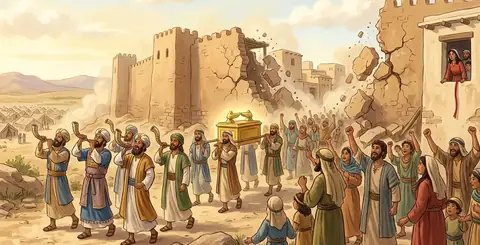 PlaceJerichoThe walled city in the Jordan valley whose walls fell flat when Israel marched round it. Called the city of palm trees…
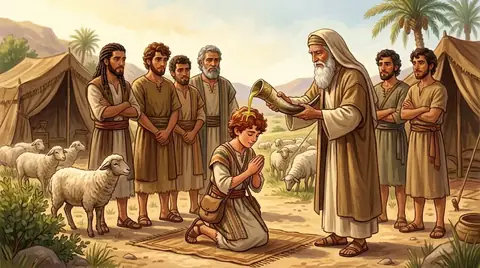 Person · KingDavidThe shepherd boy who killed Goliath and became Israel's greatest king, "a man after God's own heart". He wrote many…NationThe PhilistinesA warlike people from over the sea, settled in five cities on the coastal plain to the south-west of Israel. With iron…
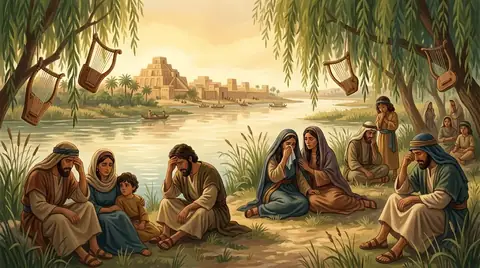 Place · CityBabylonThe great city on the Euphrates where the tower of Babel was built. Under Nebuchadnezzar it ruled the world, destroyed…
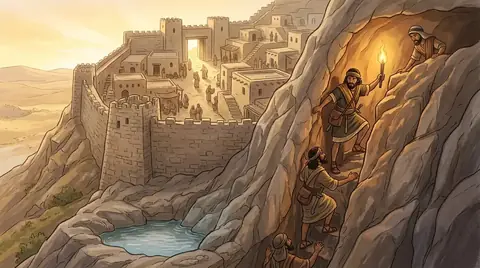 PlaceJerusalemThe city David made his capital and where Solomon built the temple. Jesus died and rose there and the church began…
Written for this app in its own words, from the Bible, with the facts checked against Bible dictionaries and encyclopedias: Easton's, Smith's, Fausset's, ISBE, Holman, the New Bible Dictionary, Vine's and the Thompson Chain topics.
