
Person
Vagabond
An old word for a wanderer, a person with no settled home
In the King James Version, someone who wanders with no fixed home. Cain was sentenced to be "a fugitive and a vagabond", and Acts speaks of "vagabond Jews" who went from place to place casting out spirits.
- Cain
- "A fugitive and a vagabond shalt thou be" (Genesis 4:12)
- In Acts
- Wandering Jewish exorcists (Acts 19:13)
The word comes from the Latin for "wandering". It does not mean a beggar or a rascal, as it often does today, but simply someone who roams about.
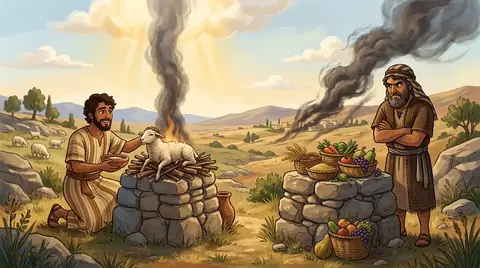
After Cain murdered his brother, God told him the ground would no longer give him its strength: "a fugitive and a vagabond shalt thou be in the earth" (Genesis 4:12). A psalm asks that the children of a wicked man be "continually vagabonds, and beg" (Psalms 109:10). In Acts, "certain of the vagabond Jews, exorcists", travelling from place to place, tried to use the name of Jesus as a charm, and the evil spirit turned on them (Acts 19:13–16).
Key verses
- Genesis 4:12
When thou tillest the ground, it shall not henceforth yield unto thee her strength; a fugitive and a vagabond shalt thou be in the earth.
- Psalms 109:10
Let his children be continually vagabonds, and beg: let them seek their bread also out of their desolate places.
- Acts 19:13–16
Then certain of the vagabond Jews, exorcists, took upon them to call over them which had evil spirits the name of the Lord Jesus, saying, We adjure you by Jesus whom Paul preacheth. And there were seven sons of one Sceva, a Jew, and chief of the priests, which did so. And the evil spirit answered and said, Jesus I know, and Paul I know; but who are ye? …
Read next
Written for this app in its own words, from the Bible, with the facts checked against Bible dictionaries and encyclopedias: Easton's, Smith's, Fausset's, ISBE, Holman, the New Bible Dictionary, Vine's and the Thompson Chain topics.
