
Custom · Law
Tassels on garments
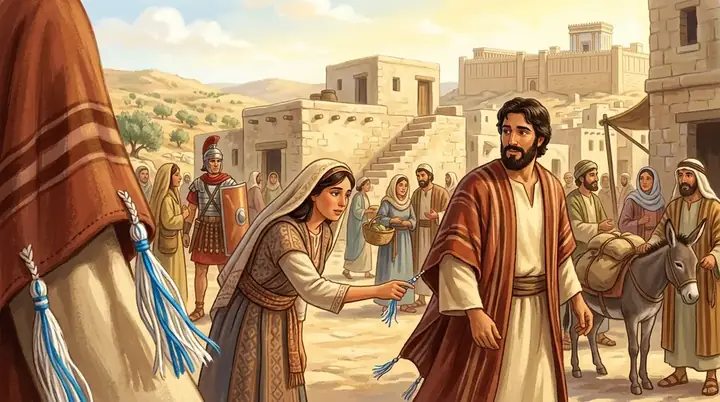
God told the Israelites to wear tassels with a blue thread on the corners of their cloaks, to remind them of his commandments. The sick woman touched one on Jesus' cloak and was healed.
- Where
- Numbers 15:37–41; Deuteronomy 22:12; Matthew 9:20; Matthew 23:5
- Hebrew
- Tzitzit, "fringe" in the KJV
What they were
Near the end of the wilderness years, God told Moses that every Israelite was to make tassels on the four corners of his outer garment and to work a thread of blue into each one (Numbers 15:37–41; Deuteronomy 22:12). The cloak was a large square of cloth, so the tassels hung at its corners and swung as a man walked. The blue was the colour of the high priest's robe and of the cloth over the ark, the colour of heaven and of holy things.
What they were for
The tassels were a reminder. "Ye may look upon it, and remember all the commandments of the LORD, and do them" (Numbers 15:39). A man would see them as he dressed, as he worked, as he sat down to eat, and be reminded whose he was, instead of following his own eyes and heart. The command ends with the reason for everything: "I am the LORD your God, which brought you out of the land of Egypt" (Numbers 15:41).
In the Gospels
Jesus wore them. The woman who had bled for twelve years came up behind him in the crowd and touched "the hem of his garment" (Matthew 9:20), that is, one of the tassels, and was healed at once. At Gennesaret the sick begged to touch the same hem (Matthew 14:36). But Jesus also warned against the Pharisees, who made their tassels long so that everyone would see how devout they were (Matthew 23:5). A reminder meant for one's own heart had become a show for others.
Key verses
- Numbers 15:38–40
Speak unto the children of Israel, and bid them that they make them fringes in the borders of their garments throughout their generations, and that they put upon the fringe of the borders a ribband of blue: And it shall be unto you for a fringe, that ye may look upon it, and remember all the commandments of the Lord, and do them; and that ye seek not after your own heart and your own eyes, after which ye use to go a whoring: That ye may remember, and do all my commandments, and be holy unto your God.
- Deuteronomy 22:12
Thou shalt make thee fringes upon the four quarters of thy vesture, wherewith thou coverest thyself.
- Matthew 9:20–22
And, behold, a woman, which was diseased with an issue of blood twelve years, came behind him, and touched the hem of his garment: For she said within herself, If I may but touch his garment, I shall be whole. But Jesus turned him about, and when he saw her, he said, Daughter, be of good comfort; thy faith hath made thee whole. And the woman was made whole from that hour.
- Matthew 23:5
But all their works they do for to be seen of men: they make broad their phylacteries, and enlarge the borders of their garments,
Read next

Written for this app in its own words, from the Bible, with the facts checked against Bible dictionaries and encyclopedias: Easton's, Smith's, Fausset's, ISBE, Holman, the New Bible Dictionary, Vine's and the Thompson Chain topics.
