
Teaching
Suicide
Taking one's own life. The Bible records a few who did, Saul, Ahithophel, Zimri and Judas among them, always at a point of ruin or despair. It also shows God meeting people in that darkness, as Paul stopped the jailer at Philippi: "Do thyself no harm."
- Instances
- Saul and his armourbearer (1 Samuel 31:4–5); Ahithophel (2 Samuel 17:23); Zimri (1 Kings 16:18); Judas (Matthew 27:5); Samson's last act (Judges 16:29–30)
- Paul
- "Do thyself no harm: for we are all here" (Acts 16:28)
In the Bible
The few suicides the Bible records come at the end of lives that had gone badly wrong. Saul, badly wounded and facing capture by the Philistines, fell on his own sword, and his armourbearer did the same (1 Samuel 31:4–5). Ahithophel, when Absalom rejected his advice, went home, set his house in order and hanged himself (2 Samuel 17:23). Zimri burned the palace over himself when his week-long reign collapsed (1 Kings 16:18). Judas, filled with remorse after betraying Jesus, threw down the silver and hanged himself (Matthew 27:3–5). Samson's death was different: he asked God for strength to die with the Philistines, and it was a final act of judgment on Israel's enemies (Judges 16:28–30).
Even Jesus was tempted at the pinnacle of the temple to throw himself down; he refused to put God to the test (Matthew 4:5–7).
God's answer
Life is God's gift and belongs to him (Job 1:21; Psalms 31:15). Elijah, Job and Jonah all asked God to let them die (1 Kings 19:4; Job 3:20–21; Jonah 4:3), and God met each of them with care, food, rest and his word. When the jailer at Philippi drew his sword to kill himself, Paul cried out, "Do thyself no harm: for we are all here," and that night he and his household found salvation (Acts 16:27–34). Anyone in that place today should know that God still says the same, and should reach out to someone who can help.
Key verses
- 1 Samuel 31:4
Then said Saul unto his armourbearer, Draw thy sword, and thrust me through therewith; lest these uncircumcised come and thrust me through, and abuse me. But his armourbearer would not; for he was sore afraid. Therefore Saul took a sword, and fell upon it.
- Matthew 27:3–5
Then Judas, which had betrayed him, when he saw that he was condemned, repented himself, and brought again the thirty pieces of silver to the chief priests and elders, Saying, I have sinned in that I have betrayed the innocent blood. And they said, What is that to us? see thou to that. And he cast down the pieces of silver in the temple, and departed, and went and hanged himself.
- 1 Kings 19:4–8
But he himself went a day’s journey into the wilderness, and came and sat down under a juniper tree: and he requested for himself that he might die; and said, It is enough; now, O Lord, take away my life; for I am not better than my fathers. And as he lay and slept under a juniper tree, behold, then an angel touched him, and said unto him, Arise and eat. And he looked, and, behold, there was a cake baken on the coals, and a cruse of water at his head. And he did eat and drink, and laid him down again. …
- Acts 16:27–31
And the keeper of the prison awaking out of his sleep, and seeing the prison doors open, he drew out his sword, and would have killed himself, supposing that the prisoners had been fled. But Paul cried with a loud voice, saying, Do thyself no harm: for we are all here. Then he called for a light, and sprang in, and came trembling, and fell down before Paul and Silas, …
Read next
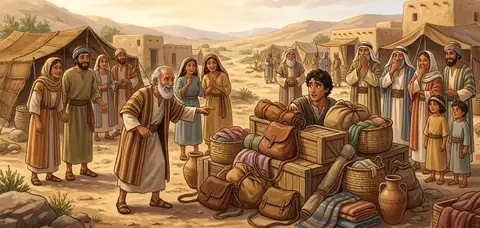 Person · KingSaulIsrael's first king, a tall Benjamite chosen when the people demanded a king like the nations. He began humbly and won…PersonAhithophelDavid's wisest adviser, whose counsel was valued like the word of God. He betrayed David to join Absalom's rebellion…PersonZimriAn army officer who killed King Elah of Israel and took the throne, but reigned only seven days. When the army made…
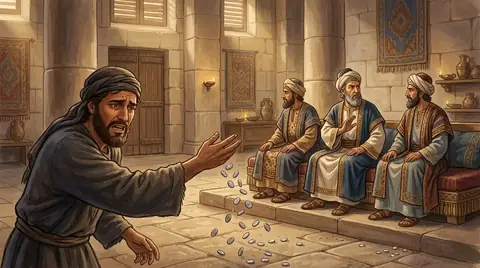 PersonJudasThe disciple who sold Jesus to the priests for thirty pieces of silver and pointed him out with a kiss. Full of…
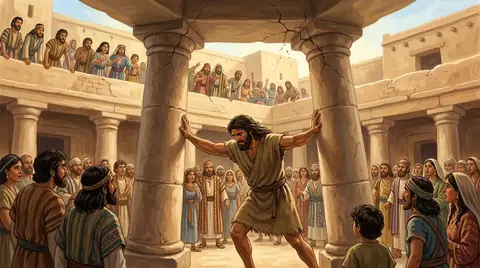 Person · JudgeSamsonThe judge of Israel with superhuman strength from God, a Nazirite from birth. He fought the Philistines single-handed…
Written for this app in its own words, from the Bible, with the facts checked against Bible dictionaries and encyclopedias: Easton's, Smith's, Fausset's, ISBE, Holman, the New Bible Dictionary, Vine's and the Thompson Chain topics.
