
Teaching
Substitution
One taking the place of another. In the sacrifices an animal died in place of the sinner; the Levites were taken in place of Israel's firstborn; and Jesus died in our place, "the just for the unjust."
- Sacrifice
- Hand laid on the animal's head (Leviticus 1:4)
- Levites
- Taken "instead of all the firstborn" (Numbers 3:12)
- Christ
- "Christ also hath once suffered for sins, the just for the unjust" (1 Peter 3:18)
In the Old Testament
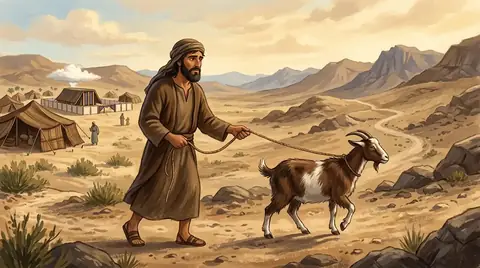
On Mount Moriah God provided a ram "in the stead of" Isaac (Genesis 22:13). The worshipper laid his hand on the head of the burnt offering, "and it shall be accepted for him to make atonement for him" (Leviticus 1:4). On the Day of Atonement Aaron laid both hands on the goat, confessed Israel's sins over it, and sent it away bearing them into the wilderness (Leviticus 16:21–22). God took the Levites for his own service instead of the firstborn of every family (Numbers 3:12, 41). The high priest bore "the iniquity of the holy things" for the people (Exodus 28:38).
In Jesus
Isaiah foretold a Servant who would be wounded for our transgressions: "the LORD hath laid on him the iniquity of us all" (Isaiah 53:5–6). Jesus said he came "to give his life a ransom for many" (Mark 10:45). Paul writes that God made him who knew no sin to be sin for us (2 Corinthians 5:21), and Peter that he bore our sins in his own body on the tree (1 Peter 2:24).
For us
This is the heart of the gospel: "Christ died for our sins" (1 Corinthians 15:3). Because he took our place, those who trust him are free. And his love calls us to lay down our lives for each other (1 John 3:16).
Key verses
- Genesis 22:13
And Abraham lifted up his eyes, and looked, and behold behind him a ram caught in a thicket by his horns: and Abraham went and took the ram, and offered him up for a burnt offering in the stead of his son.
- Leviticus 1:4
And he shall put his hand upon the head of the burnt offering; and it shall be accepted for him to make atonement for him.
- Leviticus 16:21–22
And Aaron shall lay both his hands upon the head of the live goat, and confess over him all the iniquities of the children of Israel, and all their transgressions in all their sins, putting them upon the head of the goat, and shall send him away by the hand of a fit man into the wilderness: And the goat shall bear upon him all their iniquities unto a land not inhabited: and he shall let go the goat in the wilderness.
- Isaiah 53:5–6
But he was wounded for our transgressions, he was bruised for our iniquities: the chastisement of our peace was upon him; and with his stripes we are healed. All we like sheep have gone astray; we have turned every one to his own way; and the Lord hath laid on him the iniquity of us all.
- 2 Corinthians 5:21
For he hath made him to be sin for us, who knew no sin; that we might be made the righteousness of God in him.
- 1 Peter 3:18
For Christ also hath once suffered for sins, the just for the unjust, that he might bring us to God, being put to death in the flesh, but quickened by the Spirit:
Read next
Written for this app in its own words, from the Bible, with the facts checked against Bible dictionaries and encyclopedias: Easton's, Smith's, Fausset's, ISBE, Holman, the New Bible Dictionary, Vine's and the Thompson Chain topics.
