
Symbol · Nature
Stars
Made by God, counted and named by him · a picture of his promises and his people
God made the stars and calls each by name. In the Bible they stand for Abraham's countless children, for rulers and angels, and for Christ himself, "the bright and morning star".
- Created
- On the fourth day, to give light and mark the seasons (Genesis 1:16)
- Stand for
- Abraham's offspring, rulers, angels, the wise who shine, Christ the morning star
- Not to be
- Worshipped (Deuteronomy 4:19) or consulted (Isaiah 47:13)
Made by God
The Bible treats the stars with wonder but never with fear. God made them (Genesis 1:16), he knows how many there are and calls them all by name (Psalms 147:4), and the heavens they fill "declare the glory of God" (Psalms 19:1). Job names constellations, Orion and the Pleiades, and asks who can bind them (Job 38:31). At the creation "the morning stars sang together" (Job 38:7).
The nations round Israel worshipped the sun, moon and stars and tried to read the future in them. Israel was told plainly not to (Deuteronomy 4:19), and when the kings of Judah set up altars to "all the host of heaven" on the roofs of Jerusalem, judgement followed (2 Kings 21:3; Jeremiah 19:13).
What they stand for
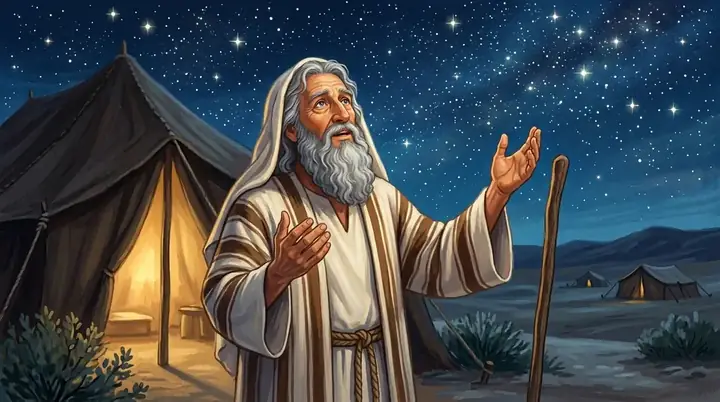
God took Abraham outside at night and told him to count the stars if he could: "So shall thy seed be" (Genesis 15:5). Ever since, a sky full of stars has been a picture of God's promise kept beyond all counting. In Joseph's dream eleven stars bowed to him, his brothers (Genesis 37:9), and in Revelation a woman is crowned with twelve stars, the people of Israel (Revelation 12:1).
Stars also stand for rulers and heavenly beings. Balaam foretold that "a Star" would come out of Jacob, a king (Numbers 24:17), which the church has always read of Christ. The fallen king of Babylon had wanted to set his throne "above the stars of God" (Isaiah 14:13). In Revelation the seven stars in Jesus' right hand are the angels, or messengers, of his seven churches (Revelation 1:20), and stars that fall are powers thrown down (Revelation 8:10; Revelation 12:4). Jude calls false teachers "wandering stars", comets that light the way to nowhere (Jude 1:13).
Points to Christ
A star led the wise men to the infant king (Matthew 2:2). Peter speaks of the day when "the day star" rises in our hearts (2 Peter 1:19), and Jesus' last word about himself in the Bible is this: "I am the root and the offspring of David, and the bright and morning star" (Revelation 22:16), the star that tells that night is nearly over. Daniel promised that those who turn many to righteousness will shine "as the stars for ever and ever" (Daniel 12:3).
Key verses
- Genesis 15:5
And he brought him forth abroad, and said, Look now toward heaven, and tell the stars, if thou be able to number them: and he said unto him, So shall thy seed be.
- Numbers 24:17
I shall see him, but not now: I shall behold him, but not nigh: there shall come a Star out of Jacob, and a Sceptre shall rise out of Israel, and shall smite the corners of Moab, and destroy all the children of Sheth.
- Daniel 12:3
And they that be wise shall shine as the brightness of the firmament; and they that turn many to righteousness as the stars for ever and ever.
- Revelation 1:20
The mystery of the seven stars which thou sawest in my right hand, and the seven golden candlesticks. The seven stars are the angels of the seven churches: and the seven candlesticks which thou sawest are the seven churches.
- Revelation 22:16
I Jesus have sent mine angel to testify unto you these things in the churches. I am the root and the offspring of David, and the bright and morning star.
Read next
 PersonAbrahamThe man God called out of Ur to a land he had never seen, promising him a people and a blessing for the whole world. He…
 Person · ProphetBalaamA soothsayer hired by the king of Moab to curse Israel. God let him go but put only blessings in his mouth; his donkey…
 PersonJacobIsaac's younger twin son, who won his brother's birthright and blessing by cunning, was changed by God, and was renamed…
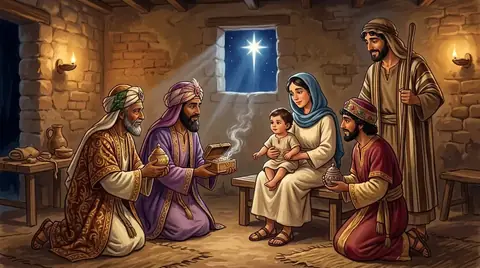 Group · PeopleThe wise men (magi)Learned men from the east who followed a star to find the new-born king of the Jews, and worshipped him with gold…
Written for this app in its own words, from the Bible, with the facts checked against Bible dictionaries and encyclopedias: Easton's, Smith's, Fausset's, ISBE, Holman, the New Bible Dictionary, Vine's and the Thompson Chain topics.
