
Teaching · Law
Sedition
Stirring up rebellion against the government. Paul's accusers charged him with it before Felix, Barabbas had been jailed for it, and Gamaliel recalled two rebels whose followers came to nothing.
- Charged against
- Paul (Acts 24:5)
- Guilty of it
- Barabbas (Mark 15:7; Luke 23:19)
- Rebels
- Theudas and Judas of Galilee (Acts 5:36–37)
Sedition means rousing people against those in authority. When Paul was brought before the governor Felix, the lawyer Tertullus called him "a pestilent fellow, and a mover of sedition among all the Jews throughout the world" (Acts 24:5). Paul answered calmly that he had stirred up no crowd and that they could prove nothing (Acts 24:12–13).
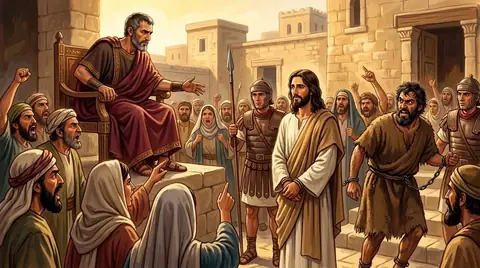
Barabbas, whom the crowd chose instead of Jesus, had been thrown into prison for an uprising and murder (Luke 23:19). Gamaliel reminded the council of Theudas and of Judas of Galilee, who led revolts and were killed, their followers scattered (Acts 5:36–37). Jesus' kingdom is not of this world, and his people are to be peaceable, honouring rulers and praying for them (John 18:36; Romans 13:1; 1 Timothy 2:1–2).
Key verses
- Acts 24:5
For we have found this man a pestilent fellow, and a mover of sedition among all the Jews throughout the world, and a ringleader of the sect of the Nazarenes:
- Luke 23:19
(Who for a certain sedition made in the city, and for murder, was cast into prison.)
- Acts 5:36–37
For before these days rose up Theudas, boasting himself to be somebody; to whom a number of men, about four hundred, joined themselves: who was slain; and all, as many as obeyed him, were scattered, and brought to nought. After this man rose up Judas of Galilee in the days of the taxing, and drew away much people after him: he also perished; and all, even as many as obeyed him, were dispersed.
- Romans 13:1
Let every soul be subject unto the higher powers. For there is no power but of God: the powers that be are ordained of God.
Read next
 PersonPaulA Pharisee who hated the church until the risen Jesus met him on the road to Damascus. He became the apostle to the…
 PersonBarabbasA rebel and murderer held in prison at the Passover when Jesus was tried. Pilate offered the crowd a choice, and the…
 PersonFelixThe Roman governor who heard Paul's case at Caesarea, trembled at his preaching about judgment, hoped for a bribe, and…
 PersonGamalielThe most respected rabbi of his day, Paul's teacher, who persuaded the Jewish council not to kill the apostles: if…
Written for this app in its own words, from the Bible, with the facts checked against Bible dictionaries and encyclopedias: Easton's, Smith's, Fausset's, ISBE, Holman, the New Bible Dictionary, Vine's and the Thompson Chain topics.
