
Thing · Daily life
Scrolls
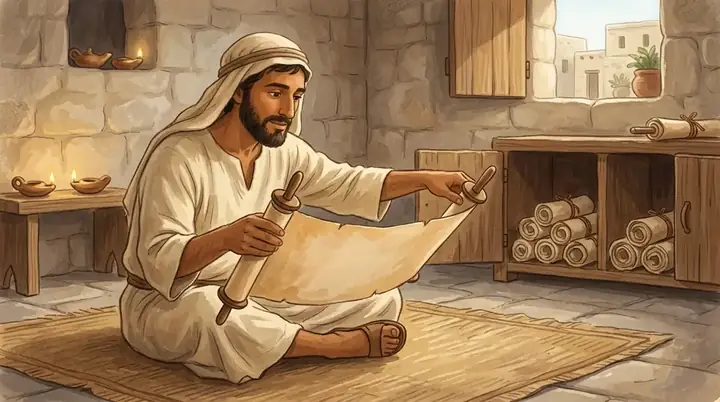
The books of Bible times: long strips of papyrus or leather, written in columns and wound on rods. A reader unrolled one side while rolling up the other. Jesus read from Isaiah's scroll at Nazareth.
- Made of
- Papyrus (reed paper) or prepared animal skin
- Also called
- A roll, a book
- Size
- Isaiah fills a scroll about 24 feet (7 m) long
What they were
Before bound books, a book was a roll. Sheets of papyrus, made from the reed that grows along the Nile, or pieces of prepared leather were joined end to end into a long strip, written on in columns, and wound round a wooden rod at one end or both. The KJV calls it a "roll" or a "book". A long book like Isaiah filled a scroll about 24 feet (7 m) long, which is one reason the Bible's books are the lengths they are.
Writing was done with a reed pen and ink made from soot and gum. Words could be scraped off leather, and a scribe kept a knife for trimming his pen and cutting the sheets.
In the Bible
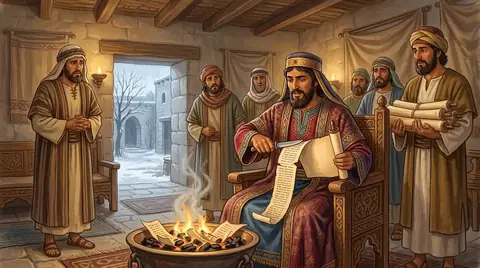
Jeremiah dictated his messages to Baruch, who wrote them on a scroll. When King Jehoiakim heard it read, he cut off the columns with his knife and burned them, and God had the whole scroll written again with more added (Jeremiah 36). Ezekiel was given a scroll written on both sides, full of lament, and told to eat it; it tasted as sweet as honey (Ezekiel 2:9–3:3). At Nazareth, in the synagogue, Jesus was handed Isaiah's scroll, unrolled it to the place he wanted, read, "closed the book" by rolling it up again, and gave it back before he sat down to teach (Luke 4:17–20). Near the end of his life Paul asked Timothy to bring his "books" and especially "the parchments" (2 Timothy 4:13). In Revelation God's purposes are a scroll sealed with seven seals that only the Lamb can open (Revelation 5:1–5), and at the end the sky itself departs "as a scroll when it is rolled together" (Revelation 6:14).
Key verses
- Jeremiah 36:2
Take thee a roll of a book, and write therein all the words that I have spoken unto thee against Israel, and against Judah, and against all the nations, from the day I spake unto thee, from the days of Josiah, even unto this day.
- Ezekiel 2:9–10
And when I looked, behold, an hand was sent unto me; and, lo, a roll of a book was therein; And he spread it before me; and it was written within and without: and there was written therein lamentations, and mourning, and woe.
- Luke 4:17–20
And there was delivered unto him the book of the prophet Esaias. And when he had opened the book, he found the place where it was written, The Spirit of the Lord is upon me, because he hath anointed me to preach the gospel to the poor; he hath sent me to heal the brokenhearted, to preach deliverance to the captives, and recovering of sight to the blind, to set at liberty them that are bruised, To preach the acceptable year of the Lord. …
- 2 Timothy 4:13
The cloke that I left at Troas with Carpus, when thou comest, bring with thee, and the books, but especially the parchments.
- Revelation 5:1
And I saw in the right hand of him that sat on the throne a book written within and on the backside, sealed with seven seals.
Read next
 PersonJeremiahThe prophet who warned Judah for forty years that Babylon was coming, and wept as it came. He was beaten, put in the…
 PersonBaruchJeremiah's faithful secretary. He wrote the prophet's words on a scroll, read them in the temple, and wrote them all…PersonJehoiakimThe king of Judah who cut up Jeremiah's scroll and burned it in his fire. Put on the throne by Pharaoh, he rebelled…
 PersonEzekielA priest and prophet taken to Babylon with the exiles from Judah. By the river Chebar he saw visions of God's glory and…
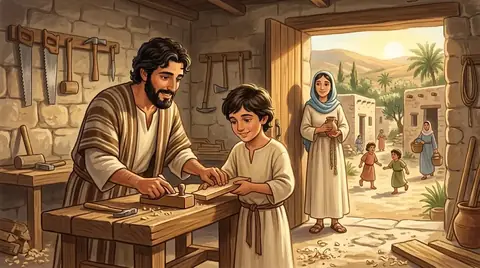 PlaceNazarethThe hill village in Galilee where Jesus grew up and where his own neighbours tried to throw him off a cliff. Gabriel…
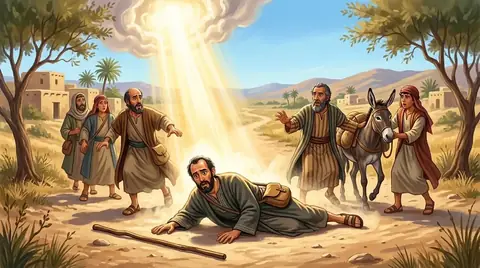 PersonPaulA Pharisee who hated the church until the risen Jesus met him on the road to Damascus. He became the apostle to the…
Written for this app in its own words, from the Bible, with the facts checked against Bible dictionaries and encyclopedias: Easton's, Smith's, Fausset's, ISBE, Holman, the New Bible Dictionary, Vine's and the Thompson Chain topics.
