
Saying · Teaching
Salt of the earth
From the Sermon on the Mount, Matthew 5:13
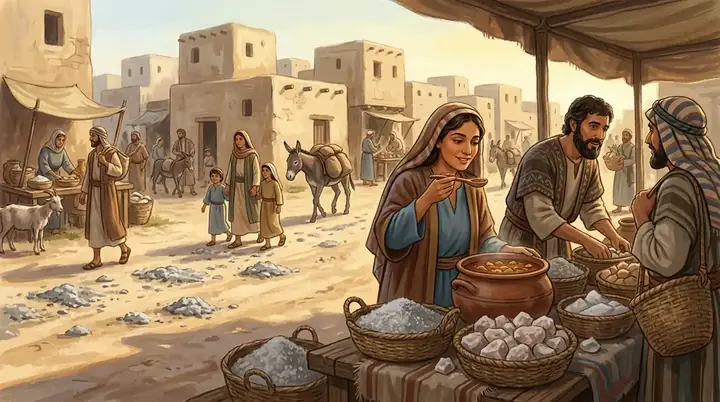
Jesus' name for his followers in the Sermon on the Mount. As salt keeps food from going bad and gives it taste, his disciples are to hold back the rot in the world and make it better by how they live.
- Where
- Matthew 5:13; Mark 9:50; Luke 14:34–35
- Paired with
- "The light of the world", the city on a hill (Matthew 5:14–16)
What Jesus said
Right after the Beatitudes, Jesus turned to the crowd of ordinary people in front of him, fishermen, farmers and housewives, and said, "Ye are the salt of the earth" (Matthew 5:13). He went on: "but if the salt have lost his savour, wherewith shall it be salted?" Then it is good for nothing but to be thrown out and walked on. In the next breath he called them "the light of the world", a lamp on a stand and a city set on a hill, impossible to hide (Matthew 5:14–16).
What it means
In a world without fridges, salt was what kept meat from rotting; it also made plain food worth eating. Jesus' people are to do both for the world around them. By living honestly, forgiving, telling the truth and loving their neighbours they hold back corruption, and they give life a flavour that makes others ask where it comes from. The salt has to be in the meat to do its work; the disciples are not told to hide from the world but to be mixed into it.
The warning is just as plain. Salt from the Dead Sea was often impure, and when the real salt washed out of it the grey dust that was left looked the same but did nothing. A Christian who has stopped being different from the world has lost the one thing that made him useful.
Elsewhere
Mark records the saying with "Have salt in yourselves, and have peace one with another" (Mark 9:50), and Luke places it after Jesus' words about the cost of following him (Luke 14:34–35). Being salt costs something.
Key verses
- Matthew 5:13
Ye are the salt of the earth: but if the salt have lost his savour, wherewith shall it be salted? it is thenceforth good for nothing, but to be cast out, and to be trodden under foot of men.
- Matthew 5:14–16
Ye are the light of the world. A city that is set on an hill cannot be hid. Neither do men light a candle, and put it under a bushel, but on a candlestick; and it giveth light unto all that are in the house. Let your light so shine before men, that they may see your good works, and glorify your Father which is in heaven.
- Mark 9:50
Salt is good: but if the salt have lost his saltness, wherewith will ye season it? Have salt in yourselves, and have peace one with another.
- Luke 14:34–35
Salt is good: but if the salt have lost his savour, wherewith shall it be seasoned? It is neither fit for the land, nor yet for the dunghill; but men cast it out. He that hath ears to hear, let him hear.
Read next
Written for this app in its own words, from the Bible, with the facts checked against Bible dictionaries and encyclopedias: Easton's, Smith's, Fausset's, ISBE, Holman, the New Bible Dictionary, Vine's and the Thompson Chain topics.
