
Thing · Farming
Plowshare
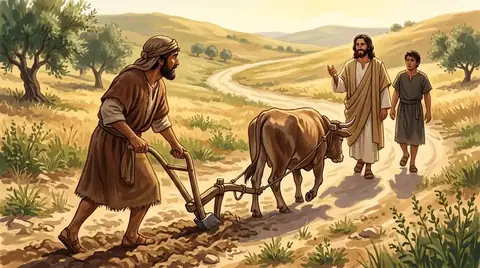
The iron blade of a plough that cuts the soil. Isaiah and Micah foresaw a day when nations would beat their swords into plowshares, while Joel turned the picture round as a call to battle.
- Peace
- Swords into plowshares (Isaiah 2:4; Micah 4:3)
- War
- Plowshares into swords (Joel 3:10)
What it was
The share was the iron point or blade fitted to the wooden plough, the part that actually broke the ground. It had to be kept sharp, and in Saul's day Israel had to go down to the Philistines to have their shares sharpened (1 Samuel 13:20).
What it meant
Isaiah and Micah both saw a vision of the last days, when the mountain of the LORD's house would be raised above the hills and all nations would come to learn his ways. Then "they shall beat their swords into plowshares, and their spears into pruninghooks: nation shall not lift up sword against nation, neither shall they learn war any more" (Isaiah 2:4; Micah 4:3). Micah adds that every man will sit under his own vine and fig tree, with no one to make him afraid (Micah 4:4).
Joel reversed the words as God summoned the nations to judgment: "Beat your plowshares into swords" (Joel 3:10). Before the lasting peace comes the last reckoning.
Key verses
- Isaiah 2:4
And he shall judge among the nations, and shall rebuke many people: and they shall beat their swords into plowshares, and their spears into pruninghooks: nation shall not lift up sword against nation, neither shall they learn war any more.
- Micah 4:3–4
And he shall judge among many people, and rebuke strong nations afar off; and they shall beat their swords into plowshares, and their spears into pruninghooks: nation shall not lift up a sword against nation, neither shall they learn war any more. But they shall sit every man under his vine and under his fig tree; and none shall make them afraid: for the mouth of the Lord of hosts hath spoken it.
- Joel 3:10
Beat your plowshares into swords, and your pruninghooks into spears: let the weak say, I am strong.
Read next
Written for this app in its own words, from the Bible, with the facts checked against Bible dictionaries and encyclopedias: Easton's, Smith's, Fausset's, ISBE, Holman, the New Bible Dictionary, Vine's and the Thompson Chain topics.
