
Animal · Insect
Palmer-worm
A crop-eating pest named with the locust in Joel and Amos. It is probably a locust at one stage of its growth, or a caterpillar; the old English name means a wandering pilgrim.
- Where
- Joel 1:4; Joel 2:25; Amos 4:9
- Hebrew
- gazam, from a word for cutting off
- Named with
- The locust, the cankerworm and the caterpillar
In the Bible
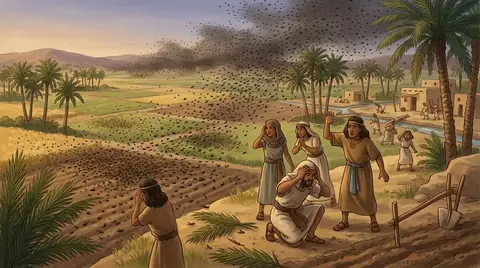
A palmer was a pilgrim who had been to the Holy Land and wandered from place to place, and the translators gave the name to a creeping pest that roams over the fields eating as it goes. The Hebrew word means something like "the cutter". Joel describes four stages of ruin: "That which the palmerworm hath left hath the locust eaten", and so on down to the caterpillar, until nothing green is standing (Joel 1:4). Many think these are the locust at different ages, from the wingless young to the flying swarm; others take them for different insects. Amos says God had sent the same plague on Israel's gardens and vineyards, fig trees and olives, "yet have ye not returned unto me" (Amos 4:9). The pest was a call to repent. And when the people did return, God promised, "I will restore to you the years that the locust hath eaten, the cankerworm, and the caterpiller, and the palmerworm" (Joel 2:25), one of the kindest promises in the Bible.
Key verses
- Joel 1:4
That which the palmerworm hath left hath the locust eaten; and that which the locust hath left hath the cankerworm eaten; and that which the cankerworm hath left hath the caterpiller eaten.
- Joel 2:25
And I will restore to you the years that the locust hath eaten, the cankerworm, and the caterpiller, and the palmerworm, my great army which I sent among you.
- Amos 4:9
I have smitten you with blasting and mildew: when your gardens and your vineyards and your fig trees and your olive trees increased, the palmerworm devoured them: yet have ye not returned unto me, saith the Lord.
Read next
Written for this app in its own words, from the Bible, with the facts checked against Bible dictionaries and encyclopedias: Easton's, Smith's, Fausset's, ISBE, Holman, the New Bible Dictionary, Vine's and the Thompson Chain topics.
