
Animal · Insect · Symbol
Locusts
Grasshopper-like insects that swarm in millions and strip a land bare. The eighth plague on Egypt was locusts, Joel describes an invading army like them, and John the Baptist ate them.
- Where
- Exodus 10:1–19; Leviticus 11:22; Joel 1:4; Joel 2:25; Matthew 3:4; Revelation 9:3–11
- Stands for
- God's judgment; an invading army; countless numbers
- As food
- Clean under the law; eaten roasted or dried
What they were
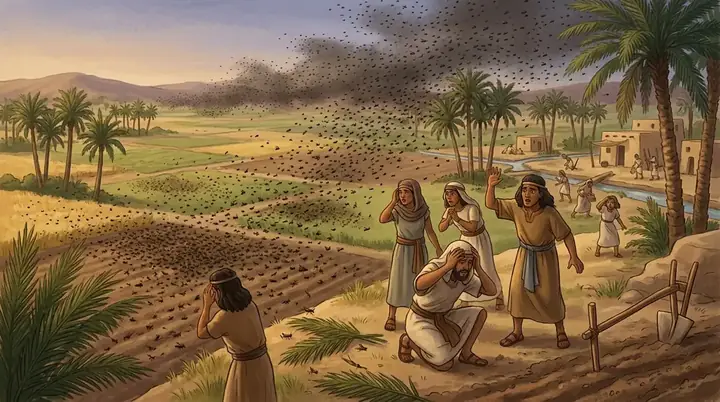
The locust is a large grasshopper. Most years they are few, but now and then they breed in vast numbers and rise into the wind in swarms that darken the sun and travel for miles. Where they land, every green thing goes: crops, leaves, bark, even wood in the house. Nothing people did could stop them. Hebrew has about ten words for them at different stages, and Joel uses four in a row for the waves of destruction (Joel 1:4).
The plague
The eighth plague on Egypt was locusts, driven in by an east wind, covering the ground so that it was black, eating whatever the hail had left. When Pharaoh begged for relief, a west wind carried every locust into the Red Sea (Exodus 10:12–19). Later God warned Israel that disobedience would bring the same ruin on their own fields (Deuteronomy 28:38).
As food
The law counted locusts clean, the only insects an Israelite might eat (Leviticus 11:22). Dried, roasted or ground into flour, they were poor people's food. John the Baptist lived on locusts and wild honey in the desert (Matthew 3:4).
As a picture
A locust swarm is the Bible's image of overwhelming numbers: the Midianites came up against Israel "as grasshoppers for multitude" (Judges 6:5). Joel saw a plague of locusts as the army of the LORD and a call to repent, and God promised, "I will restore to you the years that the locust hath eaten" (Joel 2:25). In Revelation, locusts with the sting of scorpions come out of the bottomless pit to torment the ungodly (Revelation 9:3–11).
Key verses
- Exodus 10:12–15
And the Lord said unto Moses, Stretch out thine hand over the land of Egypt for the locusts, that they may come up upon the land of Egypt, and eat every herb of the land, even all that the hail hath left. And Moses stretched forth his rod over the land of Egypt, and the Lord brought an east wind upon the land all that day, and all that night; and when it was morning, the east wind brought the locusts. And the locusts went up over all the land of Egypt, and rested in all the coasts of Egypt: very grievous were they; before them there were no such locusts as they, neither after them shall be such. …
- Leviticus 11:22
Even these of them ye may eat; the locust after his kind, and the bald locust after his kind, and the beetle after his kind, and the grasshopper after his kind.
- Joel 2:25
And I will restore to you the years that the locust hath eaten, the cankerworm, and the caterpiller, and the palmerworm, my great army which I sent among you.
- Matthew 3:4
And the same John had his raiment of camel’s hair, and a leathern girdle about his loins; and his meat was locusts and wild honey.
- Revelation 9:3
And there came out of the smoke locusts upon the earth: and unto them was given power, as the scorpions of the earth have power.
Read next
 PersonJoelThe prophet who wrote the book of Joel. He saw a plague of locusts as a warning of the day of the LORD and promised…
 Title · RulerPharaohNot a personal name but the title borne by every king of Egypt, like "Caesar". The Bible names several, the best known…
 PlaceRed SeaThe sea God parted so Israel could escape from Egypt on dry ground, and then closed over Pharaoh's army. Its crossing…
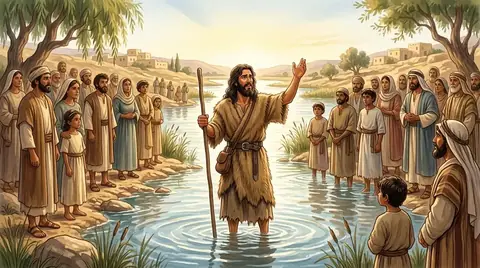 PersonJohn the BaptistThe prophet God sent to prepare the way for Jesus. He called Israel to repent, baptized in the Jordan, pointed to Jesus…
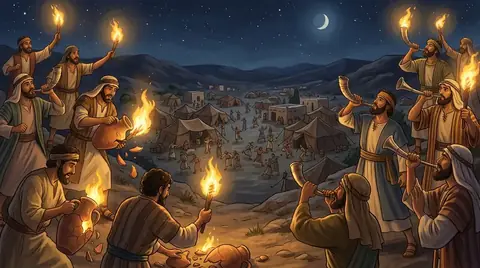 NationThe MidianitesNomads of the desert, traders and raiders, who came from Abraham. They sold Joseph into Egypt, sheltered Moses, lured…
Written for this app in its own words, from the Bible, with the facts checked against Bible dictionaries and encyclopedias: Easton's, Smith's, Fausset's, ISBE, Holman, the New Bible Dictionary, Vine's and the Thompson Chain topics.
