
Custom
Muzzle
A strap or basket over an animal's mouth. God's law said not to muzzle the ox while it trod out the grain, so it could eat as it worked; Paul applied this to paying those who preach the gospel.
- Law
- "Thou shalt not muzzle the ox when he treadeth out the corn" (Deuteronomy 25:4)
- Quoted
- 1 Corinthians 9:9–11; 1 Timothy 5:18
What it was
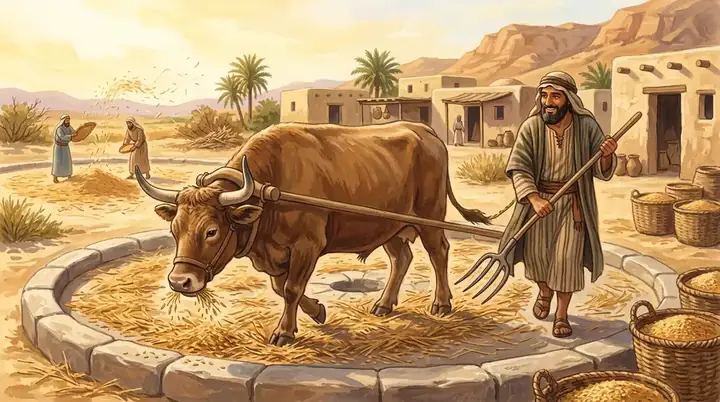
Grain was threshed by spreading the cut stalks on a hard threshing-floor and driving oxen round over them, sometimes pulling a sledge, until the kernels were trodden out. A greedy farmer might tie the ox's mouth shut to stop it eating. God's law forbade it: the animal that did the work should share in the harvest (Deuteronomy 25:4).
What it meant
The law showed God's care even for animals. Paul draws out a deeper lesson: "Doth God take care for oxen? Or saith he it altogether for our sakes?" Those who sow spiritual things may rightly reap material support (1 Corinthians 9:9–11). He quotes it again with Jesus' own saying, "The labourer is worthy of his reward", to say that elders who work hard at preaching should be paid (1 Timothy 5:17–18).
Key verses
- Deuteronomy 25:4
Thou shalt not muzzle the ox when he treadeth out the corn.
- 1 Corinthians 9:9–11
For it is written in the law of Moses, Thou shalt not muzzle the mouth of the ox that treadeth out the corn. Doth God take care for oxen? Or saith he it altogether for our sakes? For our sakes, no doubt, this is written: that he that ploweth should plow in hope; and that he that thresheth in hope should be partaker of his hope. If we have sown unto you spiritual things, is it a great thing if we shall reap your carnal things?
- 1 Timothy 5:18
For the scripture saith, Thou shalt not muzzle the ox that treadeth out the corn. And, The labourer is worthy of his reward.
Read next
Written for this app in its own words, from the Bible, with the facts checked against Bible dictionaries and encyclopedias: Easton's, Smith's, Fausset's, ISBE, Holman, the New Bible Dictionary, Vine's and the Thompson Chain topics.
