
Plant
Mulberry
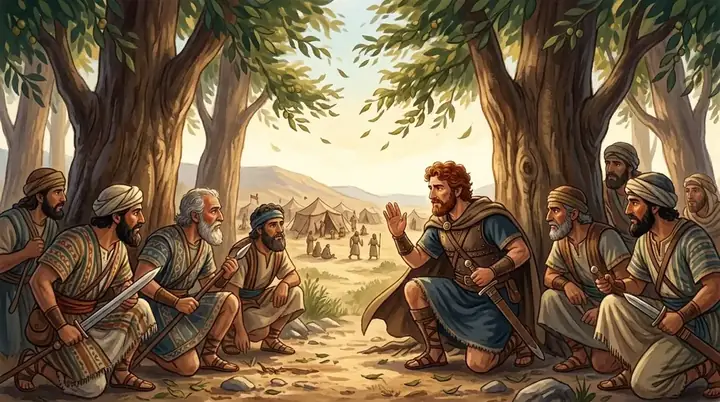
The trees in whose tops David heard "the sound of a going", God's signal to attack the Philistines. They were probably not true mulberries but a kind of poplar or balsam tree. The same word lies behind "the valley of Baca".
- Verses
- 2 Samuel 5:23–24; 1 Chronicles 14:14–15
- Hebrew
- Baka, perhaps from "to weep"
In the story
When the Philistines came up a second time against David in the valley of Rephaim, he asked the LORD what to do. God told him not to go straight at them but to circle round behind them, and to come "over against the mulberry trees. And let it be, when thou hearest the sound of a going in the tops of the mulberry trees, that then thou shalt bestir thyself: for then shall the LORD go out before thee" (2 Samuel 5:23–24). The rustling in the branches like marching feet was the sign that God's own army went ahead. David obeyed and drove the Philistines back from Geba to Gazer (2 Samuel 5:25).
The tree
The Hebrew name, baka, may come from a word for weeping, perhaps for a tree that oozes drops of sap or one whose leaves tremble. It may be a poplar or aspen, or a balsam shrub; it isn't certain. The pilgrims of Psalm 84 pass "through the valley of Baca" and make it a place of springs (Psalms 84:6).
Key verses
- 2 Samuel 5:23–25
And when David enquired of the Lord, he said, Thou shalt not go up; but fetch a compass behind them, and come upon them over against the mulberry trees. And let it be, when thou hearest the sound of a going in the tops of the mulberry trees, that then thou shalt bestir thyself: for then shall the Lord go out before thee, to smite the host of the Philistines. And David did so, as the Lord had commanded him; and smote the Philistines from Geba until thou come to Gazer.
- 1 Chronicles 14:14–15
Therefore David enquired again of God; and God said unto him, Go not up after them; turn away from them, and come upon them over against the mulberry trees. And it shall be, when thou shalt hear a sound of going in the tops of the mulberry trees, that then thou shalt go out to battle: for God is gone forth before thee to smite the host of the Philistines.
- Psalms 84:6
Who passing through the valley of Baca make it a well; the rain also filleth the pools.
Read next
Written for this app in its own words, from the Bible, with the facts checked against Bible dictionaries and encyclopedias: Easton's, Smith's, Fausset's, ISBE, Holman, the New Bible Dictionary, Vine's and the Thompson Chain topics.
