
Custom · Law
Menstruation
also called the menses; in the KJV "the custom of women", "her separation"
A woman's monthly period. Under the law of Moses it made her ceremonially unclean for seven days, as with other flows of blood. It carried no moral blame and was later used as a picture of uncleanness.
- Law
- Leviticus 15:19–30
- Unclean for
- Seven days (Leviticus 15:19)
In the law
The law treated all flows of blood and other discharges as making a person ceremonially unclean, unfit for a time to come near the holy things (Leviticus 15). A woman's period made her unclean for seven days, and what she sat or lay on likewise; a longer flow kept her unclean until it stopped, after which she brought an offering (Leviticus 15:19–30). Husband and wife were to keep apart in that time (Leviticus 18:19; Ezekiel 18:6). This was not a matter of sin but of the holiness of God's dwelling, where life and death, symbolised by blood, were kept in order.
In the stories
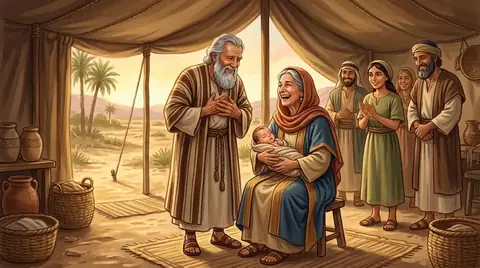
Sarah was past the age when it is "with women after the manner of women" when the promise of Isaac came (Genesis 18:11). Rachel hid her father's idols under a camel saddle and excused herself from rising, saying "the custom of women is upon me" (Genesis 31:35). The woman with a flow of blood for twelve years was, by the law, shut out and unclean; she touched Jesus' garment and was healed, and he called her "daughter" (Mark 5:25–34).
As a picture
The prophets used it of sin's defilement: Israel cast away its idols "as a menstruous cloth" (Isaiah 30:22), and Jerusalem was "as a menstruous woman" among her enemies (Lamentations 1:17).
Key verses
- Leviticus 15:19
And if a woman have an issue, and her issue in her flesh be blood, she shall be put apart seven days: and whosoever toucheth her shall be unclean until the even.
- Genesis 18:11
Now Abraham and Sarah were old and well stricken in age; and it ceased to be with Sarah after the manner of women.
- Genesis 31:35
And she said to her father, Let it not displease my lord that I cannot rise up before thee; for the custom of women is upon me. And he searched, but found not the images.
- Mark 5:25–34
And a certain woman, which had an issue of blood twelve years, And had suffered many things of many physicians, and had spent all that she had, and was nothing bettered, but rather grew worse, When she had heard of Jesus, came in the press behind, and touched his garment. …
- Isaiah 30:22
Ye shall defile also the covering of thy graven images of silver, and the ornament of thy molten images of gold: thou shalt cast them away as a menstruous cloth; thou shalt say unto it, Get thee hence.
Read next

Written for this app in its own words, from the Bible, with the facts checked against Bible dictionaries and encyclopedias: Easton's, Smith's, Fausset's, ISBE, Holman, the New Bible Dictionary, Vine's and the Thompson Chain topics.
