
Thing
Main-sail
The sail the sailors hoisted as they tried to run Paul's wrecked ship aground on Malta. The Greek word probably means a small foresail at the bow, used to steer the ship before the wind.
- Verse
- Acts 27:40
- Greek
- Artemon
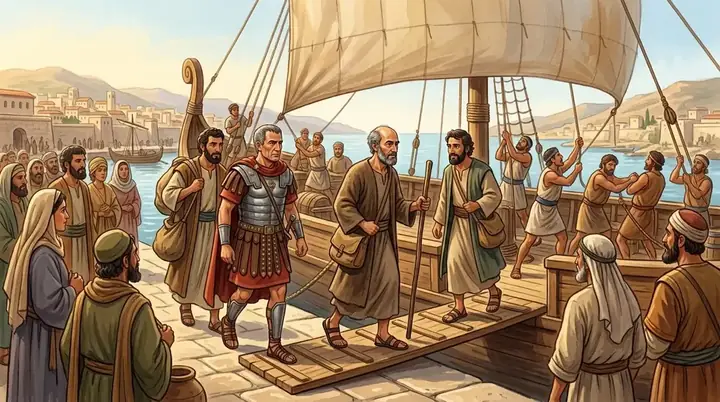
After fourteen days of storm, the ship carrying Paul to Rome came near an unknown shore at dawn. The sailors cut away the anchors, untied the ropes that held the steering oars, "and hoised up the mainsail to the wind, and made toward shore" (Acts 27:40). The Greek word is "artemon". It was probably not the great mainsail, which a storm would have torn or which had been lowered, but a small sail near the bow, enough to give the ship way and keep her head pointed at the beach. The ship struck a sandbank and broke up, yet, as God had promised Paul, all 276 on board came safe to land on Malta (Acts 27:24; Acts 27:37; Acts 27:41–44).
Key verses
- Acts 27:40–44
And when they had taken up the anchors, they committed themselves unto the sea, and loosed the rudder bands, and hoised up the mainsail to the wind, and made toward shore. And falling into a place where two seas met, they ran the ship aground; and the forepart stuck fast, and remained unmoveable, but the hinder part was broken with the violence of the waves. And the soldiers’ counsel was to kill the prisoners, lest any of them should swim out, and escape. …
- Acts 27:24
Saying, Fear not, Paul; thou must be brought before Cesar: and, lo, God hath given thee all them that sail with thee.
Read next
Written for this app in its own words, from the Bible, with the facts checked against Bible dictionaries and encyclopedias: Easton's, Smith's, Fausset's, ISBE, Holman, the New Bible Dictionary, Vine's and the Thompson Chain topics.
