
Custom · Worship
Lord's Supper
also called Communion, the breaking of bread, the Lord's table, the Eucharist
The meal of bread and wine that Jesus gave his disciples on the night before he died, to be eaten in remembrance of him until he comes. It shows his body given and his blood shed for us.
- Given
- At the Passover, the night Jesus was betrayed (Matthew 26:26–29; 1 Corinthians 11:23–25)
- Also called
- The Lord's table, the cup of blessing, the breaking of bread (1 Corinthians 10:16; 1 Corinthians 10:21; Acts 2:42)
- Until
- "Till he come" (1 Corinthians 11:26)
How it began
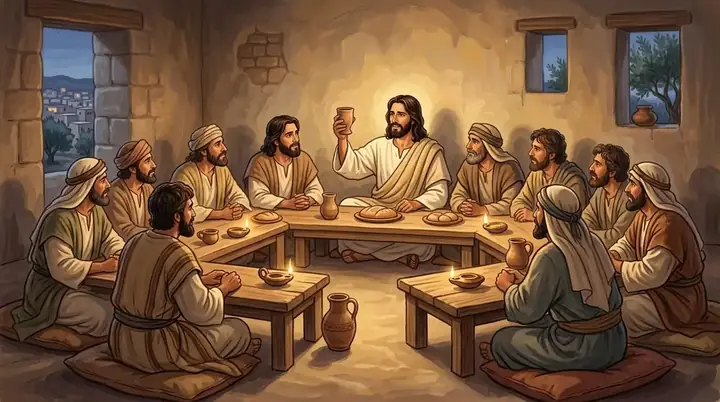
On the night he was betrayed, Jesus ate the Passover with the Twelve. He took bread, gave thanks, broke it and said, "Take, eat; this is my body." Then he took the cup and said, "this is my blood of the new testament, which is shed for many for the remission of sins" (Matthew 26:26–28). Luke and Paul add his words, "this do in remembrance of me" (Luke 22:19; 1 Corinthians 11:24–25). The Passover remembered the lamb whose blood saved Israel in Egypt; now Jesus himself was the Lamb.
In the church
From Pentecost the believers kept on "in breaking of bread, and in prayers" (Acts 2:42), meeting in homes and on the first day of the week (Acts 20:7). At first it seems to have been part of a shared meal. At Corinth the rich ate and drank while the poor went hungry, and Paul rebuked them sharply: that was not the Lord's Supper at all (1 Corinthians 11:20–22).
What it means
It looks back: "ye do shew the Lord's death till he come" (1 Corinthians 11:26). It looks up: the cup is "the communion of the blood of Christ" and the bread "the communion of the body of Christ", a real sharing in him by faith (1 Corinthians 10:16). It looks around: "we being many are one bread, and one body" (1 Corinthians 10:17). And it looks forward, to the day Jesus will drink it new with his people in his Father's kingdom (Matthew 26:29) at the marriage supper of the Lamb.
For us
Paul says to come in faith and examine ourselves, not treating it lightly (1 Corinthians 11:27–29). It is not for the sinless but for sinners who trust the Saviour whose death it shows. See also Communion.
Key verses
- Matthew 26:26–29
And as they were eating, Jesus took bread, and blessed it, and brake it, and gave it to the disciples, and said, Take, eat; this is my body. And he took the cup, and gave thanks, and gave it to them, saying, Drink ye all of it; For this is my blood of the new testament, which is shed for many for the remission of sins. …
- Luke 22:19–20
And he took bread, and gave thanks, and brake it, and gave unto them, saying, This is my body which is given for you: this do in remembrance of me. Likewise also the cup after supper, saying, This cup is the new testament in my blood, which is shed for you.
- 1 Corinthians 10:16–17
The cup of blessing which we bless, is it not the communion of the blood of Christ? The bread which we break, is it not the communion of the body of Christ? For we being many are one bread, and one body: for we are all partakers of that one bread.
- 1 Corinthians 11:23–26
For I have received of the Lord that which also I delivered unto you, That the Lord Jesus the same night in which he was betrayed took bread: And when he had given thanks, he brake it, and said, Take, eat: this is my body, which is broken for you: this do in remembrance of me. After the same manner also he took the cup, when he had supped, saying, This cup is the new testament in my blood: this do ye, as oft as ye drink it, in remembrance of me. …
- Acts 2:42
And they continued stedfastly in the apostles’ doctrine and fellowship, and in breaking of bread, and in prayers.
Read next
 FeastPassoverThe yearly feast remembering the night God rescued Israel from Egypt, when death passed over every house marked with a…
 FeastPentecost (the Feast of Weeks)The harvest feast kept fifty days after Passover, when two loaves baked from the new wheat were offered to God. On the…
 Place · CityCorinthA rich, busy port city on the narrow neck of land joining southern Greece to the mainland. Paul founded a church there…TeachingCommunionSharing life with God and with his people. The Bible speaks of communion with the Father, Son and Spirit, of believers'…
Written for this app in its own words, from the Bible, with the facts checked against Bible dictionaries and encyclopedias: Easton's, Smith's, Fausset's, ISBE, Holman, the New Bible Dictionary, Vine's and the Thompson Chain topics.
