
Teaching
Language
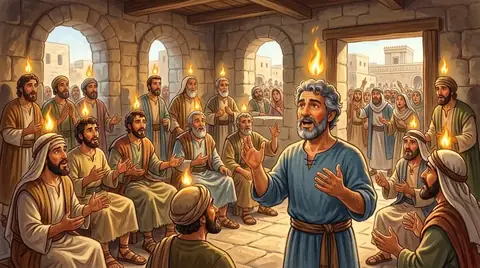
Speech and the many tongues of mankind. At Babel God scattered people by confusing their one language; at Pentecost the Spirit let the apostles speak in many, so that all could hear of Christ.
- Babel
- One language confused (Genesis 11:1–9)
- Pentecost
- Each heard in his own tongue (Acts 2:6–11)
- Named
- Hebrew, Aramaic (Syrian), Greek, Latin, Lycaonian, Egyptian
In the Old Testament
At first "the whole earth was of one language". People used that unity to build a tower to make a name for themselves, and God confused their speech and scattered them (Genesis 11:1–9). From then on the nations each had their own tongue (Genesis 10:5). Even within Israel speech differed: the men of Ephraim gave themselves away by saying "Sibboleth" (Judges 12:6). Judah's officials asked the Assyrian envoy to speak Aramaic, which the common people did not understand (2 Kings 18:26), and Nehemiah was grieved that children of mixed marriages could not speak the Jews' language (Nehemiah 13:24).
In the New Testament
Peter's Galilean accent betrayed him (Matthew 26:73). The sign over the cross was written in Hebrew, Greek and Latin (John 19:20). At Pentecost Jews from many lands each heard the apostles "speak in our tongues the wonderful works of God" (Acts 2:8–11): Babel was undone in the gospel. Paul taught that the gift of tongues in church needed an interpreter, so that all might be built up (1 Corinthians 14:27–28). In the end people of every tongue will praise the Lamb (Revelation 7:9).
Key verses
- Genesis 11:1–9
And the whole earth was of one language, and of one speech. And it came to pass, as they journeyed from the east, that they found a plain in the land of Shinar; and they dwelt there. And they said one to another, Go to, let us make brick, and burn them throughly. And they had brick for stone, and slime had they for morter. …
- Acts 2:6–11
Now when this was noised abroad, the multitude came together, and were confounded, because that every man heard them speak in his own language. And they were all amazed and marvelled, saying one to another, Behold, are not all these which speak Galileans? And how hear we every man in our own tongue, wherein we were born? …
- John 19:20
This title then read many of the Jews: for the place where Jesus was crucified was nigh to the city: and it was written in Hebrew, and Greek, and Latin.
- 1 Corinthians 14:27–28
If any man speak in an unknown tongue, let it be by two, or at the most by three, and that by course; and let one interpret. But if there be no interpreter, let him keep silence in the church; and let him speak to himself, and to God.
- Revelation 7:9
After this I beheld, and, lo, a great multitude, which no man could number, of all nations, and kindreds, and people, and tongues, stood before the throne, and before the Lamb, clothed with white robes, and palms in their hands;
Read next
Written for this app in its own words, from the Bible, with the facts checked against Bible dictionaries and encyclopedias: Easton's, Smith's, Fausset's, ISBE, Holman, the New Bible Dictionary, Vine's and the Thompson Chain topics.
