
Teaching
Justification
God's verdict of "not guilty" and "righteous" on the one who trusts in Christ
God's act of declaring a sinner righteous, forgiven and accepted, for the sake of Christ, through faith alone. It is a verdict from the Judge, given freely, not a reward for good living.
- Greek
- Dikaioō, to declare righteous, a word from the law courts
- Key text
- "being justified by faith, we have peace with God" (Romans 5:1)
- Ground
- Christ's death and righteousness, not our works (Romans 3:24–26)
The problem
Every person has broken God's law, and God is a just Judge who cannot call the guilty innocent. "There is none righteous, no, not one" (Romans 3:10). How then can anyone stand before him? Job asked it long ago: "how should man be just with God?" (Job 9:2).
In the Old Testament
The answer is as old as Abraham. He "believed in the LORD; and he counted it to him for righteousness" (Genesis 15:6). He had no law to keep and had done nothing yet; he trusted God's promise, and God credited him as righteous. David sang of the blessing of the man whose sin is covered and to whom the LORD does not count his wrongs (Psalms 32:1–2). Habakkuk gave the line that the New Testament quotes three times: "the just shall live by his faith" (Habakkuk 2:4). Isaiah foresaw the servant who would "justify many" by bearing their sins (Isaiah 53:11).
In Jesus
Paul explains it most fully in Romans and Galatians. Justification is a courtroom word, the opposite of condemnation. God does not make us righteous first and then declare it; he declares the ungodly righteous (Romans 4:5) because Jesus took their sins on the cross and gives them his own perfect obedience in exchange (2 Corinthians 5:21). So God is both "just, and the justifier" of the one who believes (Romans 3:26). Faith is not a good work that earns this; it is the empty hand that receives the gift. No one is justified by keeping the law (Galatians 2:16).
Jesus told the story of two men in the temple: a Pharisee who listed his virtues and a tax collector who could only say, "God be merciful to me a sinner". The tax collector "went down to his house justified" (Luke 18:14).
For us
Being justified brings peace with God, free access to him, and joy even in trouble (Romans 5:1–3). It cannot be lost by a bad day, because it never rested on our goodness. And it does not make us careless: those God justifies he also changes, so that real faith shows itself in good works, as James insists (James 2:17–24). The Reformation was fought over this teaching, which Luther called the article by which the church stands or falls.
Key verses
- Genesis 15:6
And he believed in the Lord; and he counted it to him for righteousness.
- Habakkuk 2:4
Behold, his soul which is lifted up is not upright in him: but the just shall live by his faith.
- Romans 3:24–26
Being justified freely by his grace through the redemption that is in Christ Jesus: Whom God hath set forth to be a propitiation through faith in his blood, to declare his righteousness for the remission of sins that are past, through the forbearance of God; To declare, I say, at this time his righteousness: that he might be just, and the justifier of him which believeth in Jesus.
- Romans 5:1
Therefore being justified by faith, we have peace with God through our Lord Jesus Christ:
- Galatians 2:16
Knowing that a man is not justified by the works of the law, but by the faith of Jesus Christ, even we have believed in Jesus Christ, that we might be justified by the faith of Christ, and not by the works of the law: for by the works of the law shall no flesh be justified.
Read next
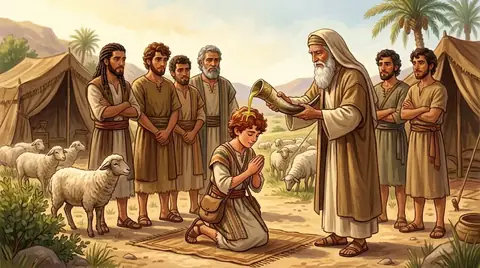 Person · KingDavidThe shepherd boy who killed Goliath and became Israel's greatest king, "a man after God's own heart". He wrote many…
 PersonHabakkukA prophet of Judah who wrote the book that bears his name. He asked God hard questions about evil and suffering, and…
 Person · ProphetIsaiahThe prophet of Jerusalem who served four kings, saw the LORD on his throne, and foretold the virgin's son, the…
Written for this app in its own words, from the Bible, with the facts checked against Bible dictionaries and encyclopedias: Easton's, Smith's, Fausset's, ISBE, Holman, the New Bible Dictionary, Vine's and the Thompson Chain topics.
