
Plant
Jonah's gourd
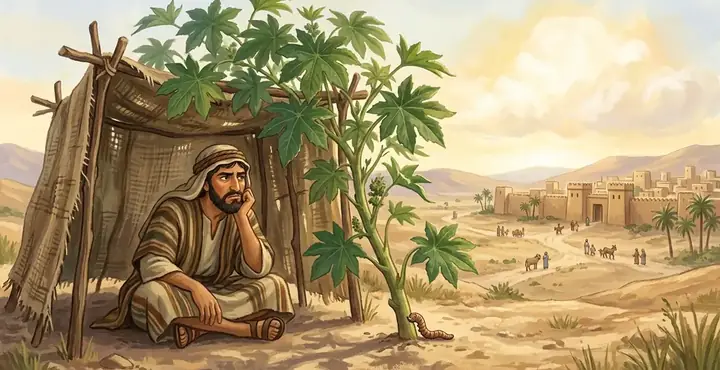
The fast-growing plant God made spring up to shade Jonah outside Nineveh, and then had a worm destroy overnight. Probably the castor-oil plant, with huge leaves on a thick stem.
- Where
- Jonah 4:6–10
- Hebrew
- Kikayon; the KJV says "gourd", others "vine" or "castor-oil plant"
- What it taught
- If Jonah could pity a plant, God could pity a city
What it was
The Hebrew name appears only here, so no one is sure. Many think it was the castor-oil plant, which shoots up several feet in a season, with broad leaves like a hand and a stem that is soft and quickly wilts if cut or eaten at the root. Others think of a gourd vine of the kind trained over booths for shade. Either way it was the sort of plant that gives much shelter and dies fast.
In the story
Jonah had built himself a rough shelter east of Nineveh to watch what would become of the city. God made the plant grow up over him in a night, and Jonah "was exceeding glad of the gourd". At dawn the next day God sent a worm to gnaw it, and it withered; then a scorching east wind and a hot sun beat on Jonah's head until he fainted and wished to die. God asked, "Doest thou well to be angry for the gourd?" Jonah said he did. Then came the point: Jonah pitied a plant he had not grown, which came in a night and went in a night; should God not pity Nineveh, with its hundred and twenty thousand children and its cattle? (Jonah 4:5–11). The plant was a parable with roots: God's love for the people Jonah hated.
Key verses
- Jonah 4:6–11
And the Lord God prepared a gourd, and made it to come up over Jonah, that it might be a shadow over his head, to deliver him from his grief. So Jonah was exceeding glad of the gourd. But God prepared a worm when the morning rose the next day, and it smote the gourd that it withered. And it came to pass, when the sun did arise, that God prepared a vehement east wind; and the sun beat upon the head of Jonah, that he fainted, and wished in himself to die, and said, It is better for me to die than to live. …
Read next

Written for this app in its own words, from the Bible, with the facts checked against Bible dictionaries and encyclopedias: Easton's, Smith's, Fausset's, ISBE, Holman, the New Bible Dictionary, Vine's and the Thompson Chain topics.
