
Book
Job (book)
Old Testament · Poetry · author not named (Jewish tradition: Moses); set in the time of the patriarchs
The story of Job, a good man who lost his wealth, his children and his health, argued with his friends about why, and finally met God himself. It wrestles with the suffering of the innocent.
- Author
- Not named; Jewish tradition credits Moses
- Set
- In the land of Uz, about the time of the patriarchs (about 2000 BC)
- Chapters
- 42
- Key verse
- "I know that my redeemer liveth" (Job 19:25)
What it's about
Job was blameless, rich and devoted to God. In heaven Satan claimed Job served God only for what he got, and God allowed him to be tested. In one day Job lost his animals, his servants and his ten children, and then he was struck with painful sores. Still he said, "the LORD gave, and the LORD hath taken away; blessed be the name of the LORD" (Job 1:21).
Three friends came to comfort him, but in long poems they insisted he must have sinned to suffer so. Job held that he was innocent and longed to put his case to God. A younger man, Elihu, spoke next. Then God answered Job out of the whirlwind with questions about creation: "Where wast thou when I laid the foundations of the earth?" (Job 38:4). Job bowed before him, and God restored him with twice what he had before.
Its message
Suffering is not always punishment for sin. God does not explain everything to us, but he is wise, good and in control, and he can be trusted in the dark. Job's friends were rebuked for speaking wrongly of God; Job, who brought his pain honestly to God, was accepted (Job 42:7).
Points to Christ
Job longed for a "daysman", someone to stand between him and God (Job 9:33), and was sure his redeemer lived. Jesus is that one mediator between God and men (1 Timothy 2:5), the innocent sufferer above all.
Key verses
- Job 1:21
And said, Naked came I out of my mother’s womb, and naked shall I return thither: the Lord gave, and the Lord hath taken away; blessed be the name of the Lord.
- Job 13:15
Though he slay me, yet will I trust in him: but I will maintain mine own ways before him.
- Job 19:25–27
For I know that my redeemer liveth, and that he shall stand at the latter day upon the earth: And though after my skin worms destroy this body, yet in my flesh shall I see God: Whom I shall see for myself, and mine eyes shall behold, and not another; though my reins be consumed within me.
- Job 38:4
Where wast thou when I laid the foundations of the earth? declare, if thou hast understanding.
- Job 42:5–6
I have heard of thee by the hearing of the ear: but now mine eye seeth thee. Wherefore I abhor myself, and repent in dust and ashes.
Read next
 PersonMosesThe man God used to bring Israel out of Egypt, give them his Law at Sinai, and lead them for forty years in the…
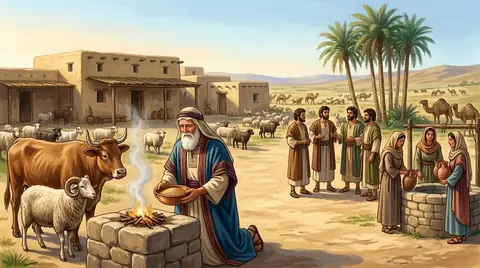 Place · LandUzThe land where Job lived, somewhere east of Israel on the edge of the desert, probably near Edom. Uz was also the name…
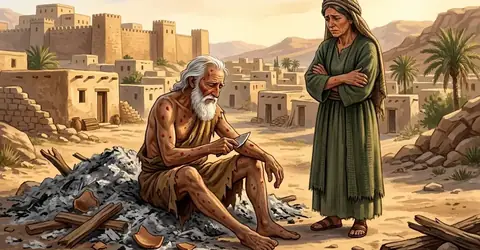 PersonJobA rich and godly man who lost his children, his wealth and his health in a single stroke, and would not curse God. His…Spirit · Enemy of GodSatan (the devil)The chief of the angels who rebelled against God, and the enemy of everything good. He tempts, accuses and deceives…
Written for this app in its own words, from the Bible, with the facts checked against Bible dictionaries and encyclopedias: Easton's, Smith's, Fausset's, ISBE, Holman, the New Bible Dictionary, Vine's and the Thompson Chain topics.
