
Plant
Husks (carob pods)
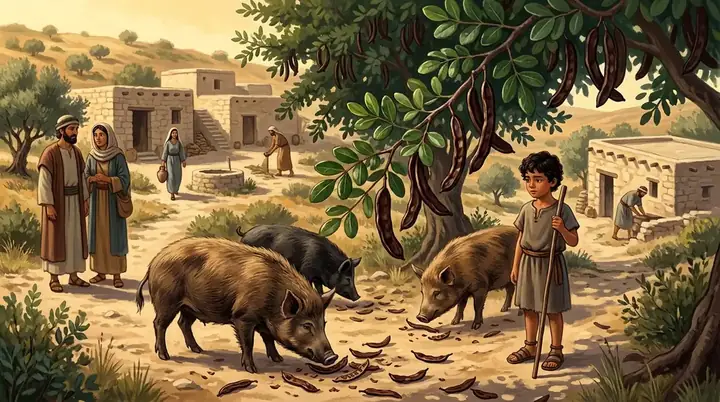
The long brown pods of the carob tree, sweet to the taste, fed to pigs and eaten by people only in desperate need. The prodigal son grew so hungry he longed to fill himself with the pigs' husks.
- Where
- Luke 15:16
- Also called
- Carob, locust bean, St John's bread
- Size
- Pods 6 to 10 inches (15 to 25 cm) long, flat and curved
What they were
The carob is an evergreen tree of the Mediterranean, and in spring it hangs with purplish flowers that grow into long brown pods, shaped a little like a horn. The pods are sweetish and were gathered as fodder for pigs and cattle; a poor family might grind them for food in a bad year. The Greek name means "little horns". Some later writers supposed that these, not insects, were the "locusts" John the Baptist ate (Matthew 3:4), so the tree came to be called St John's bread, but the Gospel means real locusts.
In the Bible
In the parable, the prodigal son has spent everything in a far country when a famine comes. He hires himself out to feed pigs, the lowest work a Jew could imagine, and "would fain have filled his belly with the husks that the swine did eat: and no man gave unto him" (Luke 15:16). It is the bottom of the pit, and there he comes to himself and heads for home (Luke 15:17–20). The husks are what sin leaves a person with: not even the pigs' food.
Key verses
- Luke 15:16–20
And he would fain have filled his belly with the husks that the swine did eat: and no man gave unto him. And when he came to himself, he said, How many hired servants of my father’s have bread enough and to spare, and I perish with hunger! I will arise and go to my father, and will say unto him, Father, I have sinned against heaven, and before thee, …
Read next
 PersonJohn the BaptistThe prophet God sent to prepare the way for Jesus. He called Israel to repent, baptized in the Jordan, pointed to Jesus…ParableProdigal SonJesus' story of a younger son who wasted his inheritance in a far country, came home in shame, and was welcomed with a…
 Event · NatureFamineA time of no food, from drought, locusts, war or siege. In the Bible famine often comes as God's judgment, and it…
Written for this app in its own words, from the Bible, with the facts checked against Bible dictionaries and encyclopedias: Easton's, Smith's, Fausset's, ISBE, Holman, the New Bible Dictionary, Vine's and the Thompson Chain topics.
