
Custom · Burial
Grave
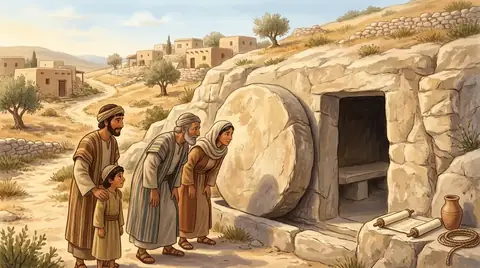
In Bible lands the dead were laid in caves or rock-cut tombs outside the town, sealed with a stone and often whitewashed. For believers the grave is not the end.
- Family tombs
- The cave of Machpelah (Genesis 23:19); the grave of Barzillai’s father and mother in his own city (2 Samuel 19:37)
- Kings
- Buried inside the city of David (1 Kings 2:10)
- Unclean
- Touching a grave made a person unclean for seven days (Numbers 19:16)
- KJV "grave"
- Often translates Sheol, the place of the dead (Psalms 49:15)
Where and how
Graves lay outside the town walls, where Jesus met the widow of Nain's funeral coming out of the gate (Luke 7:12). The rich hewed tombs out of the rock, as Shebna did on the hill and Joseph of Arimathea did for himself (Isaiah 22:16; Matthew 27:60); the poor were laid in a common burial ground (2 Kings 23:6; Jeremiah 26:23). Families were buried together: Abraham bought the cave of Machpelah and generations of his family were laid there (Genesis 23; Genesis 49:29–32), and Barzillai wished to die near the grave of his parents (2 Samuel 19:37). A pillar might mark the spot, as at Rachel's grave (Genesis 35:20). The kings of Judah were buried in the city of David itself (1 Kings 2:10). See Burial and Tombs.
Clean and unclean
Whoever touched a grave or a bone was unclean for a week (Numbers 19:16), so tombs were whitewashed each spring to warn passers-by. Jesus called the Pharisees "whited sepulchres", fine outside and full of death within (Matthew 23:27), and compared them to unmarked graves that people walk over without knowing (Luke 11:44).
Hope beyond the grave
Hosea heard God promise, "O grave, I will be thy destruction" (Hosea 13:14). Jesus called Lazarus out of a cave tomb (John 11:38–44), and on the third day his own borrowed tomb stood empty. Paul takes up Hosea's words: "O grave, where is thy victory?" (1 Corinthians 15:55). Jesus promised that all in the graves will hear his voice and come out (John 5:28–29).
Key verses
- Genesis 23:19
And after this, Abraham buried Sarah his wife in the cave of the field of Machpelah before Mamre: the same is Hebron in the land of Canaan.
- Numbers 19:16
And whosoever toucheth one that is slain with a sword in the open fields, or a dead body, or a bone of a man, or a grave, shall be unclean seven days.
- Matthew 23:27
Woe unto you, scribes and Pharisees, hypocrites! for ye are like unto whited sepulchres, which indeed appear beautiful outward, but are within full of dead men’s bones, and of all uncleanness.
- Matthew 27:60
And laid it in his own new tomb, which he had hewn out in the rock: and he rolled a great stone to the door of the sepulchre, and departed.
- Hosea 13:14
I will ransom them from the power of the grave; I will redeem them from death: O death, I will be thy plagues; O grave, I will be thy destruction: repentance shall be hid from mine eyes.
- 1 Corinthians 15:55
O death, where is thy sting? O grave, where is thy victory?
Read next
 PersonJosephJacob's favourite son, sold by his brothers into Egypt, where he rose from prison to rule the land and saved his family…
 PersonAbrahamThe man God called out of Ur to a land he had never seen, promising him a people and a blessing for the whole world. He…
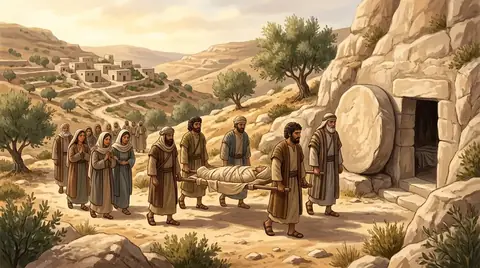 CustomBurialHow the dead were laid to rest in Bible times: quickly, in a cave or rock-cut tomb with spices and mourning, never…
 Custom · BurialSepulchreThe KJV's word for a tomb or grave. In Bible lands the dead were laid in caves or chambers cut into rock, closed with a…
Written for this app in its own words, from the Bible, with the facts checked against Bible dictionaries and encyclopedias: Easton's, Smith's, Fausset's, ISBE, Holman, the New Bible Dictionary, Vine's and the Thompson Chain topics.
