
Custom · Farming
Graft
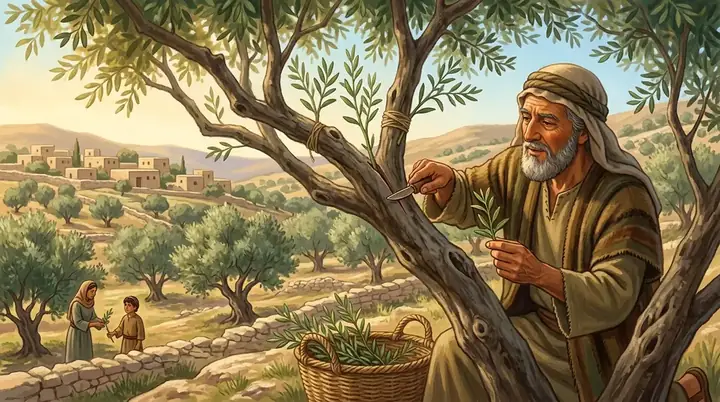
Joining a branch from one tree into the trunk of another so that it grows there. Paul uses the grafting of olive branches to show how Gentile believers are joined to God's people.
- See also
- Olive tree, Grafting
What it was
To graft, a gardener cuts a branch from one tree and fits it into a cut in another, binding them until they grow together. The branch then lives on the sap of its new root. It was commonly done with olive trees.
What it meant
In Romans 11 Paul pictures God's people as a cultivated olive tree rooted in the promises to the fathers. Some natural branches, Jews who did not believe, were broken off. Gentile believers, branches from a wild olive, were "graffed in among them" and now share "the root and fatness of the olive tree" (Romans 11:17).
So Paul warns them not to boast: "thou bearest not the root, but the root thee" (Romans 11:18). They stand by faith, and God is able to graft the natural branches in again if they turn from unbelief (Romans 11:20–24). Every believer lives only by being joined to what God planted.
Key verses
- Romans 11:17–18
And if some of the branches be broken off, and thou, being a wild olive tree, wert graffed in among them, and with them partakest of the root and fatness of the olive tree; Boast not against the branches. But if thou boast, thou bearest not the root, but the root thee.
- Romans 11:20
Well; because of unbelief they were broken off, and thou standest by faith. Be not highminded, but fear:
- Romans 11:23–24
And they also, if they abide not still in unbelief, shall be graffed in: for God is able to graff them in again. For if thou wert cut out of the olive tree which is wild by nature, and wert graffed contrary to nature into a good olive tree: how much more shall these, which be the natural branches, be graffed into their own olive tree?
Read next
Written for this app in its own words, from the Bible, with the facts checked against Bible dictionaries and encyclopedias: Easton's, Smith's, Fausset's, ISBE, Holman, the New Bible Dictionary, Vine's and the Thompson Chain topics.
