
Plant
Fir Tree
A tall evergreen of Lebanon whose timber Solomon used with cedar in the temple. The Hebrew word may mean a fir, a pine or a cypress. In the prophets it stands for the beauty God brings to a restored land.
- Hebrew
- Berosh, perhaps cypress or pine
- Used for
- The temple floor and doors (1 Kings 6:15; 1 Kings 6:34); ships' planks (Ezekiel 27:5); instruments (2 Samuel 6:5)
- See also
- Cedar, Cypress
What it was
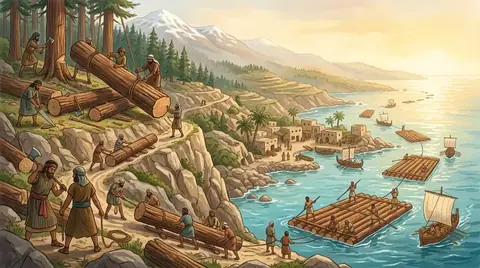
The tree grew on the mountains of Lebanon beside the cedar (Isaiah 37:24). Which tree it was isn't certain: probably a cypress or the Aleppo pine, as true firs do not grow there. Hiram of Tyre sent Solomon "timber of cedar, and timber of fir" (1 Kings 5:8–10).
How it was used
Solomon floored the temple with planks of fir and made its doors of fir wood carved with cherubim and palm trees (1 Kings 6:15; 1 Kings 6:34). David and Israel played before the LORD on instruments made of fir wood (2 Samuel 6:5). Tyre's ships were planked with fir from Senir (Ezekiel 27:5).
What it meant
Isaiah promised that "instead of the thorn shall come up the fir tree" (Isaiah 55:13), a picture of the curse turned to blessing. God says through Hosea, "I am like a green fir tree. From me is thy fruit found" (Hosea 14:8): an evergreen that never fails.
Key verses
- 1 Kings 5:8–10
And Hiram sent to Solomon, saying, I have considered the things which thou sentest to me for: and I will do all thy desire concerning timber of cedar, and concerning timber of fir. My servants shall bring them down from Lebanon unto the sea: and I will convey them by sea in floats unto the place that thou shalt appoint me, and will cause them to be discharged there, and thou shalt receive them: and thou shalt accomplish my desire, in giving food for my household. So Hiram gave Solomon cedar trees and fir trees according to all his desire.
- 1 Kings 6:15
And he built the walls of the house within with boards of cedar, both the floor of the house, and the walls of the cieling: and he covered them on the inside with wood, and covered the floor of the house with planks of fir.
- 2 Samuel 6:5
And David and all the house of Israel played before the Lord on all manner of instruments made of fir wood, even on harps, and on psalteries, and on timbrels, and on cornets, and on cymbals.
- Isaiah 55:13
Instead of the thorn shall come up the fir tree, and instead of the brier shall come up the myrtle tree: and it shall be to the Lord for a name, for an everlasting sign that shall not be cut off.
- Hosea 14:8
Ephraim shall say, What have I to do any more with idols? I have heard him, and observed him: I am like a green fir tree. From me is thy fruit found.
Read next
 Plant · SymbolThe cedarThe great tree of Lebanon, tall, fragrant and long-lasting, whose timber built Solomon's temple and palace. In the…
 Plant · TreeCypressA tall, dark evergreen with hard, sweet-smelling wood, named once in the KJV, where Isaiah mocks a man who carves an…Place · MountainsLebanonThe snow-capped mountain range north of Israel, famous for its cedars. Its timber built the temple, and its forests and…Person · KingHiramThe king of Tyre who was a friend to David and Solomon, sending cedar from Lebanon and skilled workmen for David's…
Written for this app in its own words, from the Bible, with the facts checked against Bible dictionaries and encyclopedias: Easton's, Smith's, Fausset's, ISBE, Holman, the New Bible Dictionary, Vine's and the Thompson Chain topics.
