
Number
Eight
The number that comes after the complete week of seven. In the Bible it is often tied to a fresh start: circumcision on the eighth day, eight people saved in the ark, and Jesus rising on the day after the Sabbath.
- Where
- Genesis 17:12; Leviticus 12:3; Leviticus 23:36; 1 Peter 3:20; Luke 2:21; John 20:26
- Meaning
- A new beginning, the day after the full week; an old reading, though less firm than for seven or twelve
In the Bible
Every Hebrew boy was circumcised when he was eight days old (Genesis 17:12; Leviticus 12:3), and so was Jesus (Luke 2:21). The feast of Tabernacles ran for seven days and then had a solemn closing day, the eighth (Leviticus 23:36). Aaron and his sons spent seven days being set apart and began their work as priests on the eighth (Leviticus 9:1). Eight people, Noah and his family, came through the flood into a washed world (1 Peter 3:20; 2 Peter 2:5). David, who was chosen over seven older brothers, was the eighth son of Jesse (1 Samuel 16:10–13).
What it may mean
Seven, in the Bible, is the number of a finished work: the week ends with the Sabbath. Eight is the day after that, the start of the following week. So many Christians have seen in it the thought of a new start. Jesus rose "the first day of the week" (Mark 16:2), which is the eighth day counted from the Sunday before, and he showed himself to Thomas "after eight days" (John 20:26). The church met on that day (Acts 20:7), and in later centuries baptisteries were often built with eight sides. This is a reading, not something the Bible states, and it should be held lightly.
Key verses
- Genesis 17:12
And he that is eight days old shall be circumcised among you, every man child in your generations, he that is born in the house, or bought with money of any stranger, which is not of thy seed.
- Leviticus 23:36
Seven days ye shall offer an offering made by fire unto the Lord: on the eighth day shall be an holy convocation unto you; and ye shall offer an offering made by fire unto the Lord: it is a solemn assembly; and ye shall do no servile work therein.
- Luke 2:21
And when eight days were accomplished for the circumcising of the child, his name was called JESUS, which was so named of the angel before he was conceived in the womb.
- John 20:26
And after eight days again his disciples were within, and Thomas with them: then came Jesus, the doors being shut, and stood in the midst, and said, Peace be unto you.
- 1 Peter 3:20
Which sometime were disobedient, when once the longsuffering of God waited in the days of Noah, while the ark was a preparing, wherein few, that is, eight souls were saved by water.
Read next
 Number · SymbolSevenThe Bible's number of completeness and of God's finished work, beginning with the week of creation. Sevens run through…
 NumberTwelveThe number of God's people: Israel's twelve tribes, and the twelve apostles. The new Jerusalem has twelve gates and…
 Person · The Son of GodJesus ChristThe Son of God, born of the virgin Mary, who lived a sinless life, died on a cross for the sins of the world and rose…
 Thing · WorshipThe tabernacleThe holy tent Israel built in the wilderness, by God's own pattern, so that he could dwell in the middle of his people.…
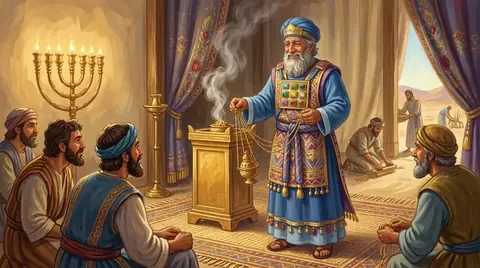 PersonAaronMoses' older brother and Israel's first high priest. He spoke for Moses before Pharaoh and served God at the tabernacle…
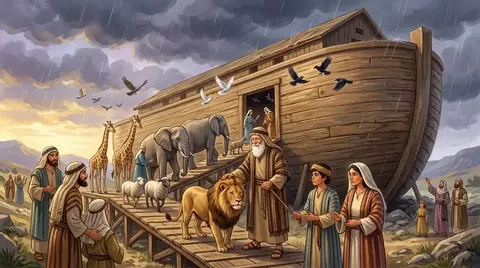 PersonNoahThe one righteous man of his age. God told him to build an ark, and through it saved him, his family and the animals…
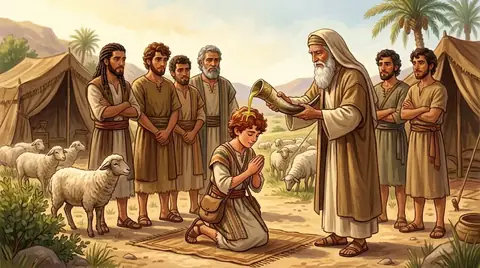 Person · KingDavidThe shepherd boy who killed Goliath and became Israel's greatest king, "a man after God's own heart". He wrote many…
Written for this app in its own words, from the Bible, with the facts checked against Bible dictionaries and encyclopedias: Easton's, Smith's, Fausset's, ISBE, Holman, the New Bible Dictionary, Vine's and the Thompson Chain topics.
