
Title of Christ
The Daysman
DAYZ-man
An old English word for an umpire who settles a quarrel. Job longed for a daysman able to put a hand on him and on God and bring them together; the church sees that longing met in Christ, the one mediator.
- Where
- Job 9:33 only
- Greek idea
- Mediator (1 Timothy 2:5; Hebrews 8:6)
Job's cry
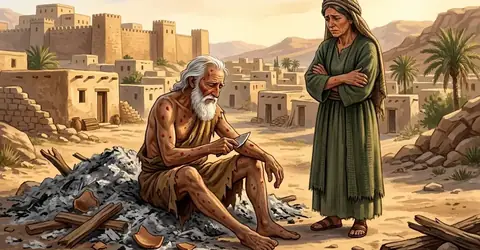
Crushed by suffering he could not explain, Job felt that God was too great to argue with. God is not a man like me, he said, that we could go to court together; "neither is there any daysman betwixt us, that might lay his hand upon us both" (Job 9:32–33). A daysman was the man both sides agreed to, who set a day to hear the case, listened to each, and gave a ruling both must accept; his hand on each shoulder was a sign of his authority over both. Job wanted someone who could reach up to God and down to him. Later he found hope: "I know that my redeemer liveth" (Job 19:25), and Elihu spoke of "a messenger, an interpreter, one among a thousand" who could show a man what is right (Job 33:23).
Answered in Christ
Paul writes that there is "one mediator between God and men, the man Christ Jesus" (1 Timothy 2:5). Being God, he can lay his hand on God; being man, he can lay his hand on us. He does more than an umpire: he settles the case by paying for our side himself. He is the Mediator Job longed for.
Key verses
- Job 9:33
Neither is there any daysman betwixt us, that might lay his hand upon us both.
- Job 19:25
For I know that my redeemer liveth, and that he shall stand at the latter day upon the earth:
- 1 Timothy 2:5
For there is one God, and one mediator between God and men, the man Christ Jesus;
- Hebrews 8:6
But now hath he obtained a more excellent ministry, by how much also he is the mediator of a better covenant, which was established upon better promises.
Read next
 PersonJobA rich and godly man who lost his children, his wealth and his health in a single stroke, and would not curse God. His…PersonElihuThe young man who waited until Job and his three friends had run out of words, then spoke at length about God's…Title of JesusThe MediatorA mediator stands between two parties who are apart and brings them together. Jesus, being both God and man, is the…
Written for this app in its own words, from the Bible, with the facts checked against Bible dictionaries and encyclopedias: Easton's, Smith's, Fausset's, ISBE, Holman, the New Bible Dictionary, Vine's and the Thompson Chain topics.
