
Plant
Bulrush
Mostly the papyrus reed
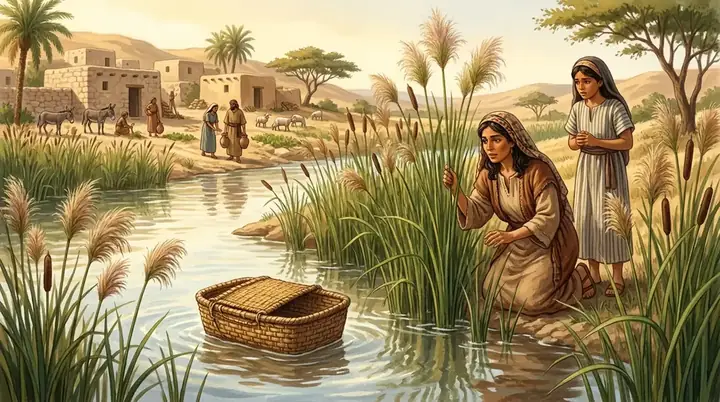
A tall marsh reed, usually the papyrus of the Nile, from which the Egyptians made boats, baskets and writing paper. Moses' mother hid him in a basket of bulrushes.
- Grew in
- Marshes and river edges (Job 8:11); the Nile in Egypt
- Used for
- Moses' basket (Exodus 2:3); light boats (Isaiah 18:2); rope; paper
What it was
The Hebrew word gome means the papyrus, a reed with a thick stem that grows three or four metres (10 to 13 feet) tall in still water. "Can the rush grow up without mire?" asks Job's friend (Job 8:11). Egypt was full of it, and the Egyptians used it for almost everything: sandals, mats, rope, light boats, and the paper that gave us the word itself. The pith was cut in strips, laid crosswise, pressed and dried. Another word, agmon, is a smaller rush whose bowed head pictures false humility in fasting (Isaiah 58:5).
In the Bible
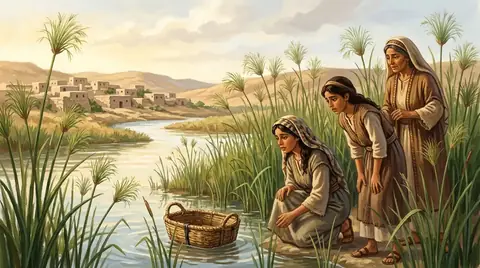
Moses' mother made "an ark of bulrushes" sealed with tar and pitch and set it among the reeds of the Nile (Exodus 2:3). Isaiah speaks of a land beyond the rivers of Ethiopia that sends envoys "in vessels of bulrushes upon the waters" (Isaiah 18:2), swift papyrus skiffs. When God makes the desert bloom, grass and reeds and rushes will grow where jackals lay (Isaiah 35:7).
See also bulrushes and papyrus.
Key verses
- Exodus 2:3
And when she could not longer hide him, she took for him an ark of bulrushes, and daubed it with slime and with pitch, and put the child therein; and she laid it in the flags by the river’s brink.
- Job 8:11
Can the rush grow up without mire? can the flag grow without water?
- Isaiah 18:2
That sendeth ambassadors by the sea, even in vessels of bulrushes upon the waters, saying, Go, ye swift messengers, to a nation scattered and peeled, to a people terrible from their beginning hitherto; a nation meted out and trodden down, whose land the rivers have spoiled!
- Isaiah 35:7
And the parched ground shall become a pool, and the thirsty land springs of water: in the habitation of dragons, where each lay, shall be grass with reeds and rushes.
Read next
Written for this app in its own words, from the Bible, with the facts checked against Bible dictionaries and encyclopedias: Easton's, Smith's, Fausset's, ISBE, Holman, the New Bible Dictionary, Vine's and the Thompson Chain topics.
