
Custom · Family
The birthright
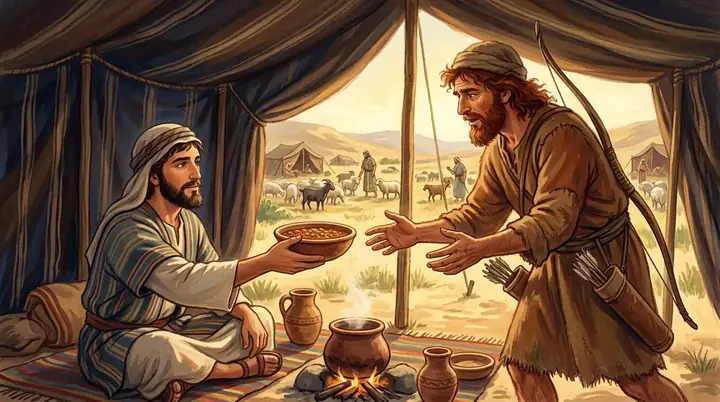
The special rights of the eldest son: a double share of what his father left and leadership of the family. Esau sold his to Jacob for a bowl of stew.
- What
- A double share of the inheritance (Deuteronomy 21:17) and headship of the family
- Lost by
- Esau, who sold it; Reuben, who sinned against his father (1 Chronicles 5:1)
What it was
The firstborn son held a special place in an Israelite family. When the father died, he received twice as much as any other son and became head of the family, and in the days before the tabernacle he would have led its worship. The law said a father could not take this right away from his eldest just because he preferred another wife's son (Deuteronomy 21:15–17).
Lost and sold
Yet in the Bible the birthright often passes elsewhere. Esau, coming in hungry from the fields, sold his to his younger twin Jacob for bread and a bowl of red lentil stew, and so "despised his birthright" (Genesis 25:29–34). Reuben, Jacob's firstborn, lost his for sleeping with his father's concubine, and it went to Joseph's sons (1 Chronicles 5:1–2). Jacob crossed his hands to bless Ephraim, the younger, above Manasseh (Genesis 48:14–19). God's choice does not always follow the order of birth.
For us
Hebrews warns believers not to be like Esau, "who for one morsel of meat sold his birthright", giving up something lasting for a moment's appetite, and finding afterwards there was no way back (Hebrews 12:16–17).
Points to Christ
Jesus is "the firstborn among many brethren" (Romans 8:29) and heir of all things; those who belong to him share his inheritance (Romans 8:17).
Key verses
- Genesis 25:29–34
And Jacob sod pottage: and Esau came from the field, and he was faint: And Esau said to Jacob, Feed me, I pray thee, with that same red pottage; for I am faint: therefore was his name called Edom. And Jacob said, Sell me this day thy birthright. …
- Deuteronomy 21:15–17
If a man have two wives, one beloved, and another hated, and they have born him children, both the beloved and the hated; and if the firstborn son be hers that was hated: Then it shall be, when he maketh his sons to inherit that which he hath, that he may not make the son of the beloved firstborn before the son of the hated, which is indeed the firstborn: But he shall acknowledge the son of the hated for the firstborn, by giving him a double portion of all that he hath: for he is the beginning of his strength; the right of the firstborn is his.
- 1 Chronicles 5:1–2
Now the sons of Reuben the firstborn of Israel, (for he was the firstborn; but, forasmuch as he defiled his father’s bed, his birthright was given unto the sons of Joseph the son of Israel: and the genealogy is not to be reckoned after the birthright. For Judah prevailed above his brethren, and of him came the chief ruler; but the birthright was Joseph’s:)
- Hebrews 12:16–17
Lest there be any fornicator, or profane person, as Esau, who for one morsel of meat sold his birthright. For ye know how that afterward, when he would have inherited the blessing, he was rejected: for he found no place of repentance, though he sought it carefully with tears.
Read next
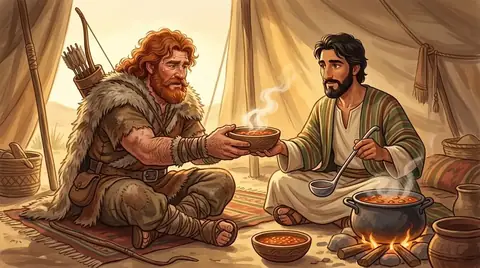 PersonEsauIsaac's elder twin, a hunter who traded away his birthright for a meal and lost his father's blessing to Jacob's trick.…
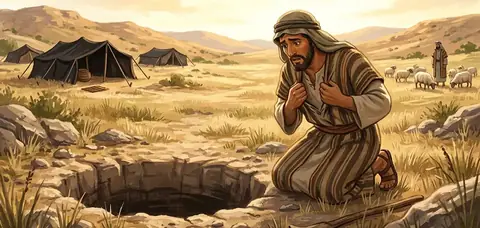 Person · TribeReubenJacob's firstborn, who lost the rights of the eldest by sleeping with his father's concubine. He tried to save Joseph…
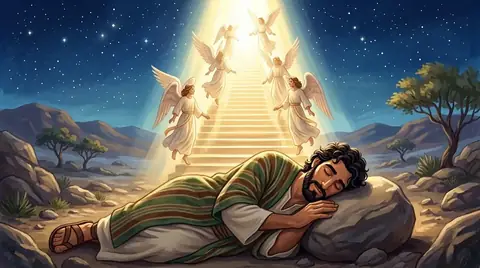 PersonJacobIsaac's younger twin son, who won his brother's birthright and blessing by cunning, was changed by God, and was renamed…
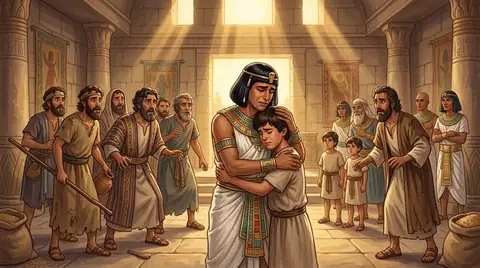 PersonJosephJacob's favourite son, sold by his brothers into Egypt, where he rose from prison to rule the land and saved his family…
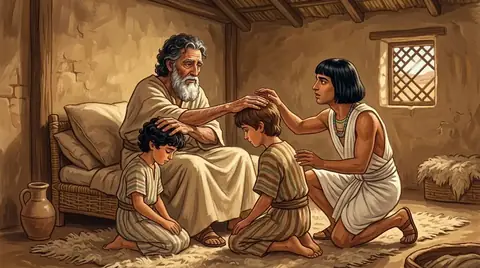 Person · TribeEphraimJoseph's second son, whom Jacob blessed ahead of his older brother. His tribe became the strongest in the north, and…Person · TribeManassehJoseph's elder son, adopted by Jacob as a tribe of Israel, whose land straddled the Jordan. Also the longest-reigning…
Written for this app in its own words, from the Bible, with the facts checked against Bible dictionaries and encyclopedias: Easton's, Smith's, Fausset's, ISBE, Holman, the New Bible Dictionary, Vine's and the Thompson Chain topics.
