
Person
Bathsheba
bath-SHEE-baOld Testament · wife of Uriah, then of David · mother of Solomon · about 1000–960 BC
The beautiful wife of Uriah whom David took and then married after having Uriah killed. Their first child died; their second was Solomon, and as queen mother she secured his throne.
- Family
- Daughter of Eliam; wife of Uriah, then of David; mother of Solomon, Shammua, Shobab and Nathan
- Known for
- David's great sin (2 Samuel 11); Solomon's succession (1 Kings 1)
- Also called
- Bath-shua (1 Chronicles 3:5)
- Meaning
- Daughter of the oath
Her story
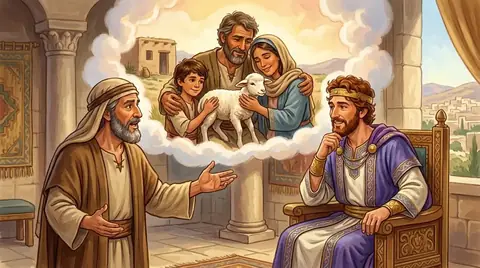
One spring evening, while his army was away besieging Rabbah, David walked on his palace roof and saw a woman bathing. He asked who she was, was told she was married to Uriah the Hittite, a soldier in his own army, and sent for her anyway. When she sent word that she was expecting a child, David called Uriah home hoping to cover it, and when Uriah would not go to his house, David had him placed in the front line and abandoned. After her mourning, Bathsheba became David's wife (2 Samuel 11). The prophet Nathan then told David a story of a rich man who stole a poor man's one lamb, and said, "Thou art the man." David repented, but the child died (2 Samuel 12:1–23; Psalms 51). God comforted them with another son, Solomon, whom Nathan called Jedidiah, "beloved of the LORD" (2 Samuel 12:24–25).
Queen mother
When David was old and Adonijah proclaimed himself king, Nathan and Bathsheba went to David and reminded him of his promise that Solomon would reign. David swore it again that day, and Solomon was anointed at Gihon (1 Kings 1:11–40). Afterwards Solomon rose to meet his mother and set a throne for her at his right hand; even so, when she carried Adonijah's request for Abishag, Solomon saw the plot behind it (1 Kings 2:13–25).
Points to Christ
Matthew's list of Jesus' ancestors names her only as "her that had been the wife of Urias" (Matthew 1:6). The line of the Saviour runs through David's worst sin, and through a woman who was wronged, to show that grace is greater than guilt.
Key verses
- 2 Samuel 11:3–4
And David sent and enquired after the woman. And one said, Is not this Bath–sheba, the daughter of Eliam, the wife of Uriah the Hittite? And David sent messengers, and took her; and she came in unto him, and he lay with her; for she was purified from her uncleanness: and she returned unto her house.
- 2 Samuel 12:24
And David comforted Bath–sheba his wife, and went in unto her, and lay with her: and she bare a son, and he called his name Solomon: and the Lord loved him.
- 1 Kings 1:28–31
Then king David answered and said, Call me Bath–sheba. And she came into the king’s presence, and stood before the king. And the king sware, and said, As the Lord liveth, that hath redeemed my soul out of all distress, Even as I sware unto thee by the Lord God of Israel, saying, Assuredly Solomon thy son shall reign after me, and he shall sit upon my throne in my stead; even so will I certainly do this day. …
- Matthew 1:6
And Jesse begat David the king; and David the king begat Solomon of her that had been the wife of Urias;
Family
- Parents
- Eliam
- Married to
- David, Uriah
- Children
- Shammua, Shobab, Nathan, Solomon
Mentioned in 12 verses
- 2 Samuel 2
- 1 Kings 8
- 1 Chronicles 1
- Psalms 1
Read next
 Person · KingDavidThe shepherd boy who killed Goliath and became Israel's greatest king, "a man after God's own heart". He wrote many…
 Person · KingSolomonDavid's son and Israel's third king, who asked God for wisdom and received riches and fame as well. He built the temple…
 PersonNathanThe prophet who told David that his son, not he, would build the temple, who confronted him over Bathsheba with the…
 PersonAdonijahDavid's fourth son, who tried to make himself king while his father lay dying. Solomon forgave him once, but when he…PersonEliamThe father of Bathsheba, who became David's wife and the mother of Solomon. He is called Ammiel in Chronicles.PersonShammuaThe spy who stood for Reuben when Moses sent twelve men to explore Canaan. The name also belongs to a son of David and…PersonShobabA son of King David born in Jerusalem, one of the four sons of Bathsheba and a brother of Solomon. Another Shobab was a…
Written for this app in its own words, from the Bible, with the facts checked against Bible dictionaries and encyclopedias: Easton's, Smith's, Fausset's, ISBE, Holman, the New Bible Dictionary, Vine's and the Thompson Chain topics. People and places: STEPBible.org (TIPNR), CC BY 4.0; where a place is today and its photo: OpenBible.info, CC BY 4.0.
