
Person · King of Moab
Balak
BAY-lakabout 1406 BC · also Balac (Rev 2:14)
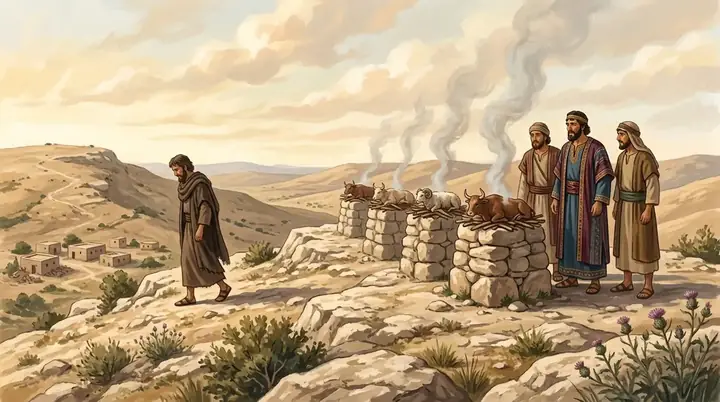
Moab's king, who paid Balaam to put a curse on Israel as they camped along his border. Seven altars on three hilltops bought him nothing but blessings on his enemies.
- Family
- Son of Zippor (Numbers 22:2)
- Known for
- Hiring Balaam; the altars on the high places of Baal, Pisgah and Peor
- Remembered in
- Joshua 24:9; Judges 11:25; Micah 6:5; Revelation 2:14
His story
Israel had just destroyed the Amorite kings Sihon and Og and camped by the Jordan opposite Jericho. Balak, king of Moab, looked out at the camp and was terrified: "this company shall lick up all that are round about us" (Numbers 22:2–4). He did not dare fight, so he sent to Balaam, a diviner famous for the power of his curses, with the elders of Moab and Midian and the fee for divination in their hands (Numbers 22:5–7).
When Balaam finally came, Balak met him at the border and took him up to a high place to see the edge of the camp. He built seven altars and offered a bull and a ram on each, and waited for the curse. Instead Balaam blessed. Balak tried a second hilltop, then a third, hoping a different view would bring a different word; each time it was worse for him (Numbers 23–24). At last he struck his hands together and shouted at the prophet to go home, and Balaam told him that no bribe could change the word of God (Numbers 24:10–13).
What came after
Balak got his revenge another way. By Balaam's advice Moab's women drew Israel into the worship of Baal-peor (Numbers 25:1–3; Numbers 31:16; Revelation 2:14).
Why he is remembered
Joshua and Micah both point to Balak as an example of what God did for Israel: an enemy who paid for a curse and was answered with a blessing (Joshua 24:9–10; Micah 6:5). Jephthah noted that Balak, for all his fear, never actually went to war with Israel (Judges 11:25).
Key verses
- Numbers 22:2–6
And Balak the son of Zippor saw all that Israel had done to the Amorites. And Moab was sore afraid of the people, because they were many: and Moab was distressed because of the children of Israel. And Moab said unto the elders of Midian, Now shall this company lick up all that are round about us, as the ox licketh up the grass of the field. And Balak the son of Zippor was king of the Moabites at that time. …
- Numbers 23:11–12
And Balak said unto Balaam, What hast thou done unto me? I took thee to curse mine enemies, and, behold, thou hast blessed them altogether. And he answered and said, Must I not take heed to speak that which the Lord hath put in my mouth?
- Numbers 24:10–13
And Balak’s anger was kindled against Balaam, and he smote his hands together: and Balak said unto Balaam, I called thee to curse mine enemies, and, behold, thou hast altogether blessed them these three times. Therefore now flee thou to thy place: I thought to promote thee unto great honour; but, lo, the Lord hath kept thee back from honour. And Balaam said unto Balak, Spake I not also to thy messengers which thou sentest unto me, saying, …
- Joshua 24:9–10
Then Balak the son of Zippor, king of Moab, arose and warred against Israel, and sent and called Balaam the son of Beor to curse you: But I would not hearken unto Balaam; therefore he blessed you still: so I delivered you out of his hand.
- Micah 6:5
O my people, remember now what Balak king of Moab consulted, and what Balaam the son of Beor answered him from Shittim unto Gilgal; that ye may know the righteousness of the Lord.
On the map
Family
- Parents
- Zippor
Mentioned in 41 verses
- Numbers 37
- Joshua 1
- Judges 1
- Micah 1
- Revelation 1
Read next
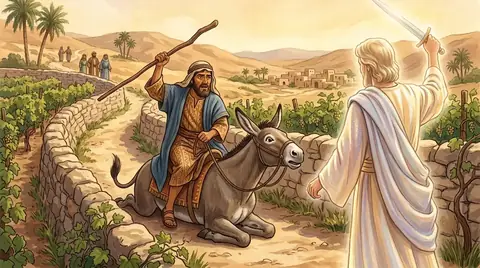 Person · ProphetBalaamA soothsayer hired by the king of Moab to curse Israel. God let him go but put only blessings in his mouth; his donkey…
 Place · NationMoabThe land and people east of the Dead Sea, descended from Lot. Balak of Moab hired Balaam to curse Israel, Moses died on…IdolBaal-peorThe god of Moab worshipped on Mount Peor. Balaam's advice drew Israel into feasting and immorality with the Moabite…
 PersonJoshuaMoses' helper who took over from him and led Israel across the Jordan into the Promised Land. He fought the wars of…PersonZipporBalak's father. Balak, king of Moab, hired Balaam to curse Israel. Nothing else is told about Zippor.
Written for this app in its own words, from the Bible, with the facts checked against Bible dictionaries and encyclopedias: Easton's, Smith's, Fausset's, ISBE, Holman, the New Bible Dictionary, Vine's and the Thompson Chain topics. People and places: STEPBible.org (TIPNR), CC BY 4.0; where a place is today and its photo: OpenBible.info, CC BY 4.0.
