
Custom · War
Army
Israel's fighting men, counted by tribe and led by captains of thousands and hundreds. There was no standing army until the kings; before that every man over twenty was called up when war came.
- Who served
- Every man twenty and over (Numbers 1:3), except the Levites and those newly married, building or planting (Deuteronomy 20:5–8)
- Led by
- Captains of thousands, hundreds and fifties (Numbers 31:14; 2 Kings 1:9)
- Called up by
- Trumpet (Judges 3:27), or pieces of an ox sent round the tribes (1 Samuel 11:7)
- Numbers
- 603,550 at Sinai (Numbers 1:46); 1,300,000 in David's census (2 Samuel 24:9)
In the wilderness and the judges
Israel left Egypt marching in ranks (Exodus 13:18), and at Sinai Moses counted every man able to fight, tribe by tribe (Numbers 1). Each tribe camped and marched under its own banner (Numbers 2). In battle the men were grouped in thousands and hundreds with captains over them. Before fighting, a priest spoke to the army and the officers sent home anyone who had just built a house, planted a vineyard or become engaged, and anyone who was afraid (Deuteronomy 20:1–9). Gideon used that rule to shrink his force from thirty-two thousand to three hundred (Judges 7:3–7).
There were no professionals. Farmers left their fields when the trumpet blew and went home when the fighting stopped. Israel was told not to collect horses (Deuteronomy 17:16), and fought on foot with sword, spear, bow and sling. Her real strength was never in numbers: "the battle is the LORD's" (1 Samuel 17:47).
Under the kings
Saul kept three thousand picked men about him (1 Samuel 13:2), the start of a standing army. David built his around the band of outlaws who had followed him in the wilderness, with his thirty mighty men and a foreign bodyguard, the Cherethites and Pelethites (2 Samuel 23:8–39; 2 Samuel 15:18). He organised twelve divisions of twenty-four thousand, each serving one month a year (1 Chronicles 27:1–15). Solomon added chariots and horsemen, stabled in chariot cities (1 Kings 10:26). Later kings counted their soldiers in hundreds of thousands, and the prophets warned that this was where their trust was going instead of to God (Isaiah 31:1; Psalms 20:7).
In the New Testament
The armies in the Gospels are Roman. Soldiers came to John the Baptist and were told to be content with their pay (Luke 3:14); a centurion's faith amazed Jesus (Matthew 8:5–10). Paul borrowed the soldier's kit for the armour of God (Ephesians 6:11–17) and called Timothy to endure hardness "as a good soldier of Jesus Christ" (2 Timothy 2:3). At the end the armies of heaven follow the rider on the white horse (Revelation 19:14).
Key verses
- Numbers 1:3
From twenty years old and upward, all that are able to go forth to war in Israel: thou and Aaron shall number them by their armies.
- Deuteronomy 20:1–4
When thou goest out to battle against thine enemies, and seest horses, and chariots, and a people more than thou, be not afraid of them: for the Lord thy God is with thee, which brought thee up out of the land of Egypt. And it shall be, when ye are come nigh unto the battle, that the priest shall approach and speak unto the people, And shall say unto them, Hear, O Israel, ye approach this day unto battle against your enemies: let not your hearts faint, fear not, and do not tremble, neither be ye terrified because of them; …
- 1 Samuel 17:47
And all this assembly shall know that the Lord saveth not with sword and spear: for the battle is the Lord’s, and he will give you into our hands.
- Psalms 20:7
Some trust in chariots, and some in horses: but we will remember the name of the Lord our God.
- 2 Timothy 2:3
Thou therefore endure hardness, as a good soldier of Jesus Christ.
Read next
 Person · KingSaulIsrael's first king, a tall Benjamite chosen when the people demanded a king like the nations. He began humbly and won…
 Person · KingDavidThe shepherd boy who killed Goliath and became Israel's greatest king, "a man after God's own heart". He wrote many…
 Person · KingSolomonDavid's son and Israel's third king, who asked God for wisdom and received riches and fame as well. He built the temple…
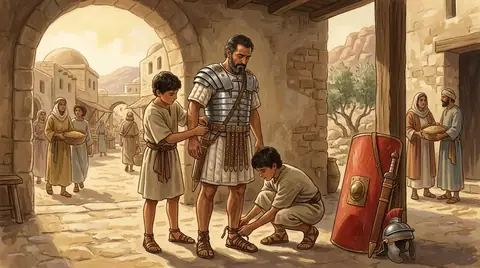 Symbol · Christian lifeThe armour of GodPaul's picture of how a believer stands firm against the devil: truth, righteousness, the gospel of peace, faith…
Written for this app in its own words, from the Bible, with the facts checked against Bible dictionaries and encyclopedias: Easton's, Smith's, Fausset's, ISBE, Holman, the New Bible Dictionary, Vine's and the Thompson Chain topics.
