
Place · Building
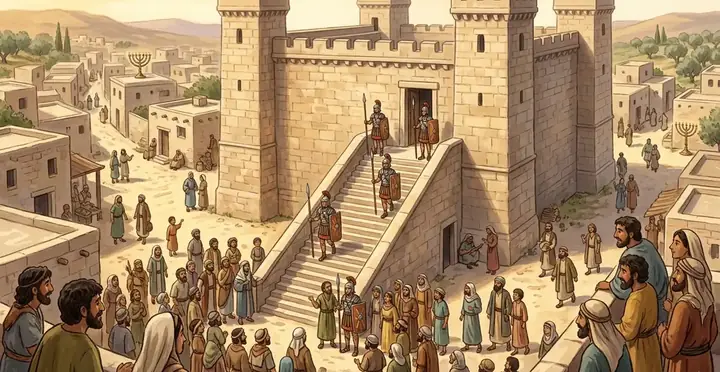
The Antonia fortress
the "castle" of Acts 21–23
The Roman barracks that overlooked the temple courts in Jerusalem, which Herod the Great rebuilt and named for Mark Antony. Soldiers from it rescued Paul from the mob and kept him there.
- Where
- On a rock at the temple area's north-western corner, above the courts
- Built by
- Herod the Great, on the site of an older fort, named for his patron Mark Antony
- Known for
- Paul carried up its steps; Pilate may have tried Jesus here
What it was
A fortress stood on the north-western side of the temple in Jerusalem, so high on its rock that from its towers soldiers could watch everything in the courts below. Herod the Great rebuilt it on a grand scale and named it after Mark Antony, the Roman general who had helped him to his throne. Josephus describes it as a palace inside a fort, with a tower at each corner and baths and courtyards within.
The Romans kept a garrison there. At the great feasts, when Jerusalem was full and tempers ran high, the soldiers stood on the walls to watch the crowds, and two flights of stairs ran straight down from the fortress into the temple court so they could reach a riot in minutes.
In the Bible
That is exactly what happened to Paul. When the crowd in the temple tried to beat him to death, the commander ran down with his men, and the soldiers had to carry Paul up the steps because of the press of the crowd. From the stairs Paul asked to speak, and told the people how he had met Jesus (Acts 21:31–40; Acts 22). Inside "the castle", as the King James Bible calls it, he was about to be flogged when he said he was a Roman citizen (Acts 22:24–29). His nephew came there to warn him of a plot, and from there Paul was sent by night to Caesarea (Acts 23:16–32).
Some think Pilate judged Jesus at this fortress, since the governor stayed there at feasts, and so the Way of the Cross begins near its site; others place the trial at Herod's palace on the west of the city. The Bible doesn't say.
Today
The fortress was destroyed with the temple in AD 70. Its rock can still be seen at the corner of the temple mount, and a convent stands where its courtyard is thought to have been.
Key verses
- Acts 21:34–37
And some cried one thing, some another, among the multitude: and when he could not know the certainty for the tumult, he commanded him to be carried into the castle. And when he came upon the stairs, so it was, that he was borne of the soldiers for the violence of the people. For the multitude of the people followed after, crying, Away with him. …
- Acts 21:40
And when he had given him licence, Paul stood on the stairs, and beckoned with the hand unto the people. And when there was made a great silence, he spake unto them in the Hebrew tongue, saying,
- Acts 22:24
The chief captain commanded him to be brought into the castle, and bade that he should be examined by scourging; that he might know wherefore they cried so against him.
- Acts 23:10
And when there arose a great dissension, the chief captain, fearing lest Paul should have been pulled in pieces of them, commanded the soldiers to go down, and to take him by force from among them, and to bring him into the castle.
Read next
 Thing · WorshipThe TempleGod's house in Jerusalem, where he was worshipped and the sacrifices offered. Solomon built it, Babylon burned it, the…
 Person · KingHerodThe name of a family of rulers under Rome. Herod the Great tried to kill the infant Jesus; his son Antipas beheaded…
 PersonPaulA Pharisee who hated the church until the risen Jesus met him on the road to Damascus. He became the apostle to the…
Written for this app in its own words, from the Bible, with the facts checked against Bible dictionaries and encyclopedias: Easton's, Smith's, Fausset's, ISBE, Holman, the New Bible Dictionary, Vine's and the Thompson Chain topics. Also: Josephus, Jewish War 5.5.
