
Teaching
Anger
The hot feeling that rises when something seems wrong. The Bible treats it as natural, but warns that it turns to sin when it is quick, unfair or nursed, and tells us to be slow to it.
- Known for
- "Be ye angry, and sin not" (Ephesians 4:26)
- Examples
- Cain, Moses, Saul, Ahab, Naaman, Jonah, Herod
- Greek
- orgē (settled anger), thumos (a burst of rage)
The problem
Anger is part of being human. It flares up when we see something bad, and in itself it is no more sinful than love is. The trouble is what it so easily becomes: anger with no good cause, anger out of all proportion, or anger kept warm for days and years. Then it leads to hard words, broken friendships and worse. The first murder began with a brother's angry face (Genesis 4:5–8).
In the Old Testament
The Bible is full of people whose anger did them harm. Moses struck the rock in a rage and lost his way into the Promised Land (Numbers 20:10–12). Saul threw a spear at his own son in a fit of fury (1 Samuel 20:30–34). Ahab sulked because Naboth would not sell him a vineyard (1 Kings 21:4). Naaman nearly missed his healing because the prophet's instructions offended him (2 Kings 5:11–12). Jonah was angry enough to die over a withered plant (Jonah 4:9).
Proverbs returns to the subject again and again. A soft answer turns anger away; a hot-tempered man stirs up strife; "he that is slow to anger is better than the mighty" (Proverbs 15:1; Proverbs 15:18; Proverbs 16:32).
The anger of God
When the Bible speaks of God's anger, it means his settled displeasure with sin and with those who cling to it (Psalms 7:11). It is never a loss of control. God is "slow to anger, and plenteous in mercy" (Psalms 103:8), and his anger passes, while his love does not (Psalms 30:5).
In Jesus
Jesus said that anger with a brother puts us in danger of judgment just as murder does, because it is the seed of murder (Matthew 5:22). Yet Jesus himself was angry in the synagogue at hearts too hard to care about a crippled man (Mark 3:5), and drove the traders out of the temple. His anger was always on behalf of others, never for himself.
For us
Paul's rule is short: be angry if you must, but do not sin, and do not let the sun go down on it (Ephesians 4:26). James adds that everyone should be quick to listen, slow to speak and slow to anger, because our anger does not produce the righteousness God wants (James 1:19–20). Anger that is handed over to God the same day cannot grow into bitterness.
Key verses
- Genesis 4:6–7
And the Lord said unto Cain, Why art thou wroth? and why is thy countenance fallen? If thou doest well, shalt thou not be accepted? and if thou doest not well, sin lieth at the door. And unto thee shall be his desire, and thou shalt rule over him.
- Proverbs 16:32
He that is slow to anger is better than the mighty; and he that ruleth his spirit than he that taketh a city.
- Matthew 5:22
But I say unto you, That whosoever is angry with his brother without a cause shall be in danger of the judgment: and whosoever shall say to his brother, Raca, shall be in danger of the council: but whosoever shall say, Thou fool, shall be in danger of hell fire.
- Ephesians 4:26
Be ye angry, and sin not: let not the sun go down upon your wrath:
- James 1:19–20
Wherefore, my beloved brethren, let every man be swift to hear, slow to speak, slow to wrath: For the wrath of man worketh not the righteousness of God.
Read next
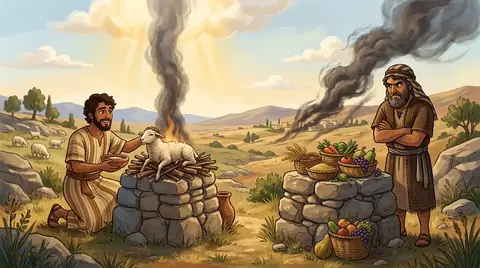 PersonCainThe first child born into the world, and the first murderer. Jealous because God accepted his brother Abel's offering…
 PersonMosesThe man God used to bring Israel out of Egypt, give them his Law at Sinai, and lead them for forty years in the…
 Person · KingSaulIsrael's first king, a tall Benjamite chosen when the people demanded a king like the nations. He began humbly and won…
 Person · KingAhabThe seventh king of the northern kingdom of Israel, who married Jezebel and led the nation into Baal worship. He…
 PersonNaamanThe Syrian general who had leprosy and was healed when he humbled himself and washed seven times in the Jordan at…
 PersonJonahThe prophet who ran from God's call to preach at Nineveh, was swallowed by a great fish, and then sulked when the city…
 Person · KingHerodThe name of a family of rulers under Rome. Herod the Great tried to kill the infant Jesus; his son Antipas beheaded…
Written for this app in its own words, from the Bible, with the facts checked against Bible dictionaries and encyclopedias: Easton's, Smith's, Fausset's, ISBE, Holman, the New Bible Dictionary, Vine's and the Thompson Chain topics.
